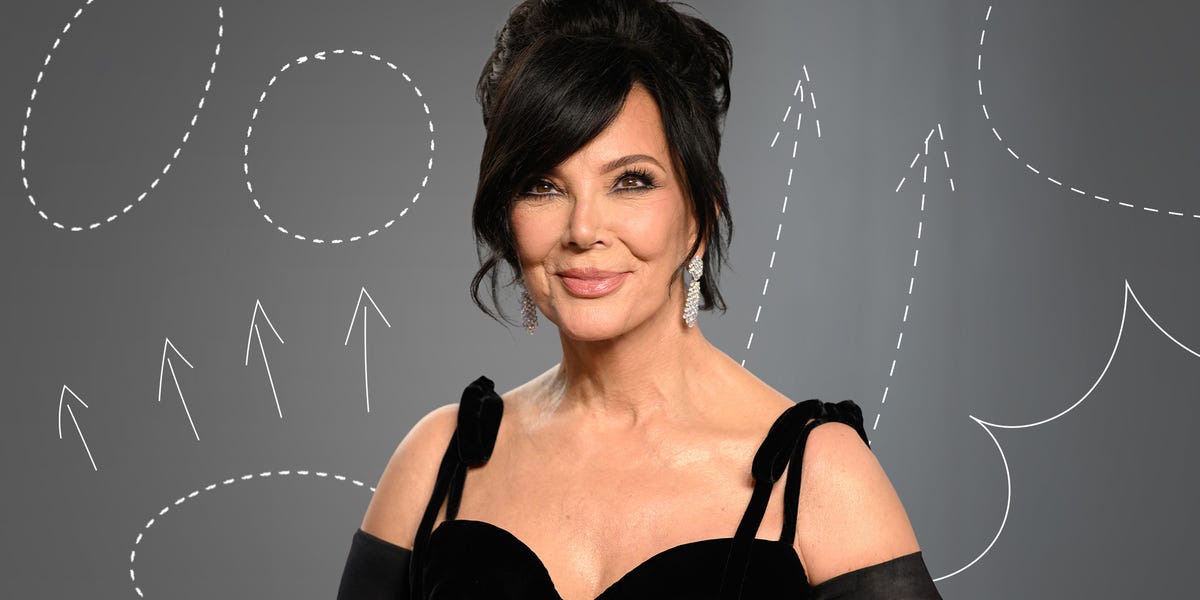
Anyone who spends significant money and downtime investing in a surgically lifted and rejuvenated face would be, understandably, rather dismayed to discover that the facelift didn’t “take.” Or that it only lasts as long as the effects of, say, a lunchtime laser treatment. This is the crux of the latest hoopla surrounding Kris Jenner’s facelift, the surgery that launched a thousand posts and stories a year ago and is doing so again: that its magical effects already seem to be, er, slipping away.
But is that what we are really seeing here? A woman who didn’t get her money’s worth? A facelift that, somehow, didn’t work? In short, no. “Predictably, the tissues of the face appear slightly less taut than did a year ago, which represents a typical pattern seen with facelift surgery,” says NYC-area facial plastic surgeon Dr. Jeffrey Wise.
Additionally, it’s important to note that our first glimpse of a post-surgery Kris likely benefitted from a little residual swelling, as counterintuitive as that may seem. “There's absolutely a sweet spot for swelling after facelifts,” Wise explains. “During this time, the facelift is maximally lifted, and there is just enough swelling to produce skin turgidity that effaces the majority of wrinkles at the operative site.” Beverly Hills facial plastic surgeon Dr. Babak Azizzadeh agrees that, for a while after surgery, part of the effect you’re seeing is that temporary added volume. “Post-op swelling is always present and can be expected to last for up to six months or more,” he says.
After that time, Wise says, “The ‘settling’ of facelifts is a completely anticipated and an ordinary part of the healing process. Facelifts that fully drop are extremely unusual, especially with modern facelifting techniques.”
So, no slippage. But there are exceptions, even if Jenner isn’t one of them. “Facelift ‘failures’ can result with poor surgical technique or unusual patient factors such as extreme weight fluctuations following the procedure” Wise notes. “Careful preoperative consultation is key. For example, if someone was planning to lose a significant amount of weight via dieting, medication, or surgery, I would wait until they were relatively close to their target weight before performing a facelift procedure.”
The Jenner facelift frenzy has also highlighted the deep plane vs SMAS debate in the medical aesthetics world. Practitioners of the former feel its benefits include greater lift longevity, though hard data is tough to come by due to the subjectivity inherent in assessing aesthetic outcomes. But Jenner went to a surgeon known for his (excellent) SMAS technique, and some point to this as a factor. “In the long run, [performing a facelift] without addressing the deeper muscles makes it hard to have a long lasting and natural appearance,” says Dr. Lesley Rabach, a Manhattan facial plastic surgeon.
So how long SHOULD a facelift last? “I counsel most of my patients that a deep plane facelift should last approximately 10 to 15 years,” says Wise, who also performs deep plane lifts. “After the initial healing process, which takes several months, the facelift will gradually settle over the next decade. This is largely due to the normal aging process, rather than the facelift itself.” A patient’s age, lifestyle, and number of prior surgeries will also affect durability. “Younger patients should expect a longer lasting result,” says Azizzadeh.
A last, critical factor in assessing facelift longevity: honest photos. That first, fetus-like glimpse we saw of Jenner last year, on the eve of the Bezos wedding extravaganza, likely benefitted from professional makeup, A+ lighting, and that trusty Kardashian filter. Some recent photos may just be more accurate representations of Jenner’s face. Apple, meet orange. Only undoctored, unretouched photos can tell a true story.
“We have a dedicated photography studio, which creates consistent before-and-after photos using the same camera, lighting, backgrounds and angles. I encourage patients not to wear makeup for any photos taken to accurately monitor their progress,” Wise says. “Extremely retouched photographs can grossly misrepresent a patient's skin quality and the degree of lift they have achieved with the procedure.” Perhaps one day, we will finally and truly grasp that no aesthetic procedure can possibly live up to the standards of said procedure combined with Facetune.