JERUSALEM — Early on a cool autumn morning in 2023, from a tunnel beneath the Gaza Strip, Yahya Sinwar gave an order that sent thousands of Hamas fighters through the fence separating the territory from Israel. That green light has reordered the Middle East on a scale comparable to the Arab Spring or the carving up of the Ottoman Empire in the early 20th century — but not remotely in the ways Sinwar had in mind.
Twenty-nine months later, the Middle East is almost unrecognizable. Israel stands indisputably as the military hegemon, its enemies demolished or decapitated. Saudi Arabia is emerging as a pivotal economic and political anchor, its Persian Gulf neighbors reeling under Iranian missile fire. Palestinians, mourning 75,000 dead in a shattered Gaza and losing territory in the West Bank, seem marginalized — by everyone, again.
Sinwar is dead — assassinated by Israel in October 2024 — and after nearly two and a half years of bloodshed and upheaval, the network he hoped would ride to his rescue is in ruins. Iranian Supreme Leader Ali Khamenei was blown up in a joint U.S.-Israeli airstrike on Saturday. The regime that bankrolled and armed the “axis of resistance” for four decades is on the edge of collapse — perhaps taking with it Hamas, Hezbollah and the Houthis.
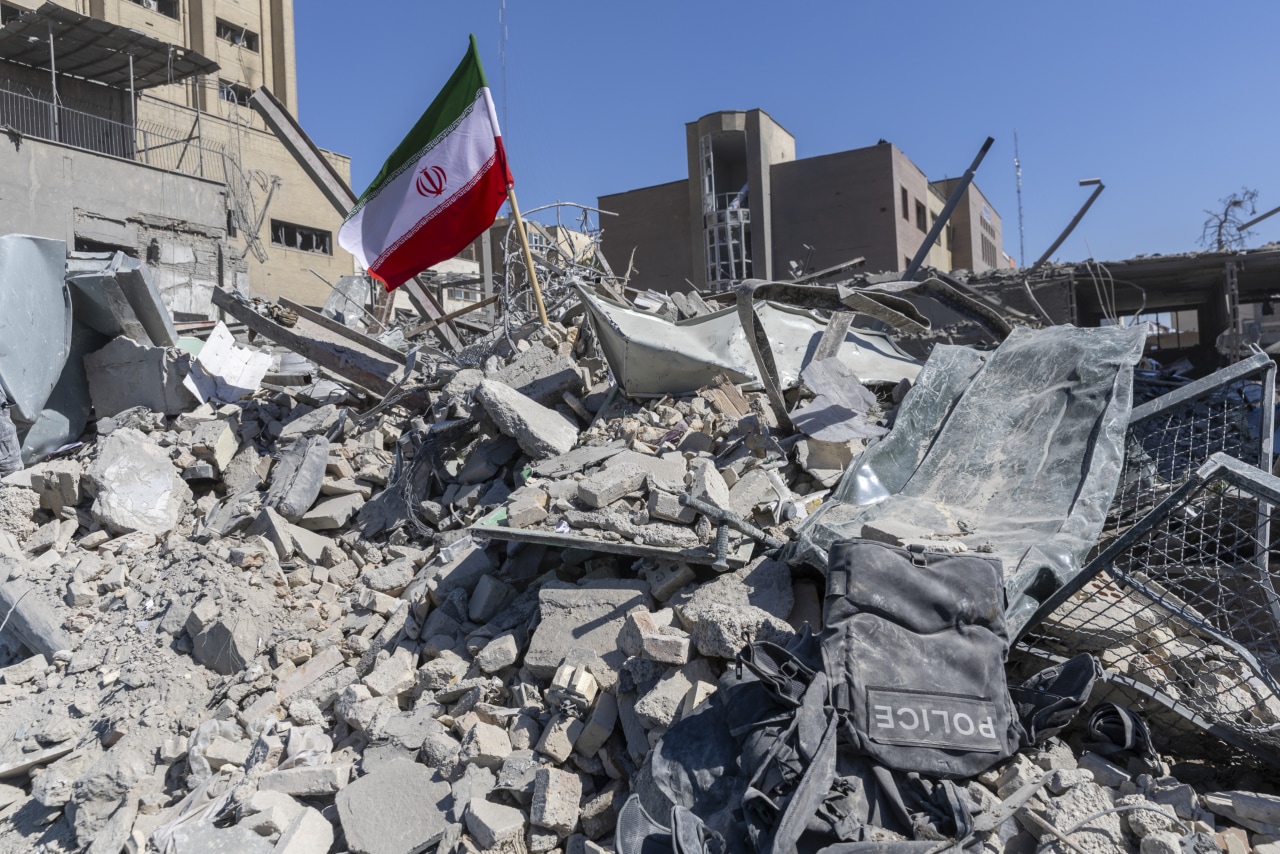
Tehran, facing a chaotic and uncertain succession, is making enemies of the entire region — firing drones and missiles haphazardly, and often vainly including civilian targets. Bashar al-Assad, the longtime Syrian ruler, now lives in frigid Moscow.
Driving the military campaign and aiming to shape the region’s future is Prime Minister Benjamin Netanyahu, who has survived repeated government collapses, an arrest warrant by the International Criminal Court and years of corruption trials to lead Israel to an unprecedented military dominance. And President Donald Trump, who overcame two impeachments, a felony conviction and an assassination attempt to return to the White House and take the United States to war against Iran without a vote of Congress.
While Israel has faced allegations of genocide, a new generation of Israelis are now bearing the traumas of war, like their parents, grandparents and great-grandparents. And while American soldiers are once again dying in the Middle East in a war of uncertain duration and unclear goals, what Sinwar set off was not a liberation but an unraveling of everything he and his sponsors yearned for — a defeated Israel, Palestinian hopes for statehood, a Middle East rid of Western influence. The so-called Great Satan looks more like the Great Decider.
“Talk about a colossal miscalculation leading to catastrophic consequences,” said Bilal Saab, a Chatham House fellow and former Pentagon official in the first Trump administration. “That cataclysmic event single-handedly changed the face of the Middle East.”
But what these changes ultimately yield remains one of the most consequential open questions in modern geopolitics. The old order — Iran as the region’s disruptive spine, its proxies as the tools of pressure and deterrence — is gone. What replaces it is an unpredictable mix of competing ambitions, fresh grievances, destroyed cities and ungoverned spaces.
Israel is dominant but isolated, its neighbors wondering — and worrying — what it will do with its power and how it will deal with ongoing hatred of its vanquished enemies. The gulf states, including the signers of Trump’s Abraham Accords, are shaken and skeptical of American guarantees. Saudi Arabia and Turkey are repositioning, but for what and against whom are not yet known. Much could depend on who or what comes next in Tehran, where Khamenei’s demise has left a vacuum.
European colonialists put their pencils to a map after World War I to divide up deserts, wadis and mountains, dismantle the crumbling Ottoman Empire and create the modern Middle East. The Arab Spring of 2011 cracked it. What unfolds now could come from a new mold entirely.
“This has changed the region forever,” said Ali Vaez, director of the Iran Project at the International Crisis Group. “But with what consequences still has to play out.”
Proxy forces
On Oct. 6, 2023, it was all different. Iran’s proxy network was, by most measures, at the peak of its power. Hamas governed Gaza. Hezbollah held Lebanon hostage with 100,000 rockets. Assad sat in Damascus, reintegrating into the Arab League after years of isolation. The Houthis controlled the Yemeni coast and menaced shipping lanes with near-impunity.
Behind them all stood Iran, with a nuclear program viewed as an imminent threat in Jerusalem and the West, backed by a missile arsenal regarded as a strong deterrent against direct Israeli or American attack. Gulf nations were quietly reestablishing ties with the Islamic republic.
“Two years later, none of those pillars are standing, and the Islamic republic is never going to be the same,” Vaez said. “Iran as a country that can determine the trajectory of the region is no longer.”
The clearest beneficiary is Israel, which has viewed Iran as its existential nemesis for decades. Since Oct. 7, 2023, Israel has neutralized every major threat on its borders, struck the Iranian homeland repeatedly and now killed its mortal enemy’s supreme leader.
Many within Israel’s security establishment believe the country is more secure within its borders now than at any time since its founding in 1948, despite the Iranian missiles still falling, and the still-smoldering rubble in Gaza.
“We are still traumatized from 7th October. There is still war,” said a former senior Israel Defense Forces official who remains close to military leaders and who, like others interviewed for this article, spoke on the condition of anonymity to discuss sensitive issues. “But I can tell you that no one but the biggest dreamers ever thought we would be in the position we are in now. Israel is not untouchable, but we have made it very expensive to touch us.”
Israeli officials say that they want to use their supremacy for regional good, and that they hope Iranians will one day enjoy freedom.
Peace through strength
“When this is over, I think you’re going hear our leaders talk about Israel’s desire for peace through strength,” said an Israeli official. “We are going to fight our enemies as strongly as possible and hug our friends as close as possible.”
Historically, Israel has justified its massive military as a shield against hostile neighbors, a defensive crouch that gave it little experience with more political or economic leadership in the region.
“I would describe Israel as a reluctant hegemon,” Saab said. “It has a tremendous capacity to defeat its enemies, but it has shown no interest in propping up political systems in place of what they have destroyed.”
The focus on security comforts Israelis but unnerves their neighbors. An Israel unbound by regional rivals raises fears of overreach and adventurism — especially in the West Bank. The worries will spike if the United States, given the likelihood that Trump declares victory over Iran, pulls back from the Middle East or otherwise gives Jerusalem a free hand.
“As much as gulf leaders would love to see the Iranian regime gone,” Saab said, “they also worry about the trigger-happiness of Israel.”
How Israel exercises its dominance may depend on what follows in Iran once the missiles and drones run out, which some Western military experts say could happen within days.
Trump has exhorted Iranians onto the streets to seize power for themselves. But few with experience in the region predict that a freely elected government is likely anytime soon, even if citizens rise up against the regime forces that killed more than 6,800 protesters in January, according to advocacy groups.
An organized opposition has yet to emerge. Factions within the regime are already maneuvering for power. A military junta of Islamic Revolutionary Guard Corps officers could succeed the regime they now serve.
Nor does the crack-up of the Iranian axis guarantee an end to the terrorism and militancy it generated. Hezbollah continues to fire missiles at Israel and even Cyprus. Houthi rebels, masters of their mountainous badlands in Yemen, could target shipping in the Red Sea for years to come.
Uncertainty and disorder
The threats could widen — and perhaps include sectarian strife.
“Ayatollah Khamenei was not just a head of state,” said Shira Efron, a Tel Aviv-based fellow at Rand, the security think tank. “He was a religious leader for something like 200 million Shiites worldwide.”
In any case, Shahed drones setting tourist zones ablaze have exploded whatever hopes Iran harbored for better ties with its Muslim neighbors. By striking hotels, apartments, ports and embassies in the United Arab Emirates, Saudi Arabia, Bahrain and other nations, what’s left of the regime in Tehran has ensured even more extreme isolation.
“The level of psychological damage the Iranians have done to the sense of security in these countries is enormous,” said a former U.S. diplomat in the region. “Iran will be more and more isolated economically and politically. It’s a country of 90 million people that could become more like North Korea.”
Emerging as unlikely co-tenants of whatever order is to come are Saudi Arabia and Turkey. Riyadh has the money and the legitimacy; Ankara has the agility and the ambition. Neither fully trusts the other. Both are watching Israel’s dominance with unease and Washington’s erratic stewardship with skepticism.
Both are hedging — deepening ties with China, courting India, keeping lines open to Russia — even as they remain, for now, in the American orbit.
And both are being watched by the gulf states, battered and newly vulnerable, as well as by every capital from Cairo to Pakistan’s Islamabad.
What none of them can yet see is the shape of the thing being born. The old Middle East had a logic, however brutal: Iran as a disrupter, America as a guarantor, Israel as a contained power, the gulf states as financiers of stability.
What replaces it will be decided in Trump’s whims as a real estate developer and self-proclaimed peacemaker, in Tehran’s succession struggle, in Riyadh’s throne rooms, in Ankara’s presidential palace and in the rubble of Gaza — where Sinwar’s great gamble ended not in liberation but in ash and blood, and where the Middle East’s next chapter, unwritten and unpredictable, has already begun.