In 1933, decades before modern engineering standards, construction began on the Golden Gate Bridge.
Now, nearly a century later, a 206-page engineering report looked at a worrying prospect: the risk of a massive ship striking the base of a tower.
The Golden Gate Bridge, the analysis found, is exceptionally safe.
"We're very happy that those who designed the bridge designed it the way they did so we don't have to worry," Golden Gate Bridge District Engineer John Eberle said at the March meeting of the district's board of directors.
Engineers modeled worst-case scenarios, including ships veering off course, striking at speed and hitting critical supports, according to the report published in March. They found the bridge has multiple layers of defense that make collapse extremely unlikely.
The study estimates the probability of a ship strike causing a collapse at roughly 1 in 40,000 to 70,000 in any given year. The modern benchmark is less than 1 in 10,000.
And those estimates don't take account of nonstructural safety measures like tug escorts and vessel traffic control, meaning the actual risk is likely even lower.
The report was commissioned by the bridge district following the collapse of the Francis Scott Key Bridge in Baltimore, which was due to a ship strike. Concern quickly surged nationwide about whether other major bridges, especially older ones, could withstand similar impacts. The National Transportation Safety Board identified 68 bridges across the U.S. and recommended their owners take on complex vulnerability assessments, including San Francisco's landmark span.
The Bay Bridge was not subject to this recommendation, but Bay Area Toll Authority staff are preparing to brief officials on vessel strike vulnerabilities next month.
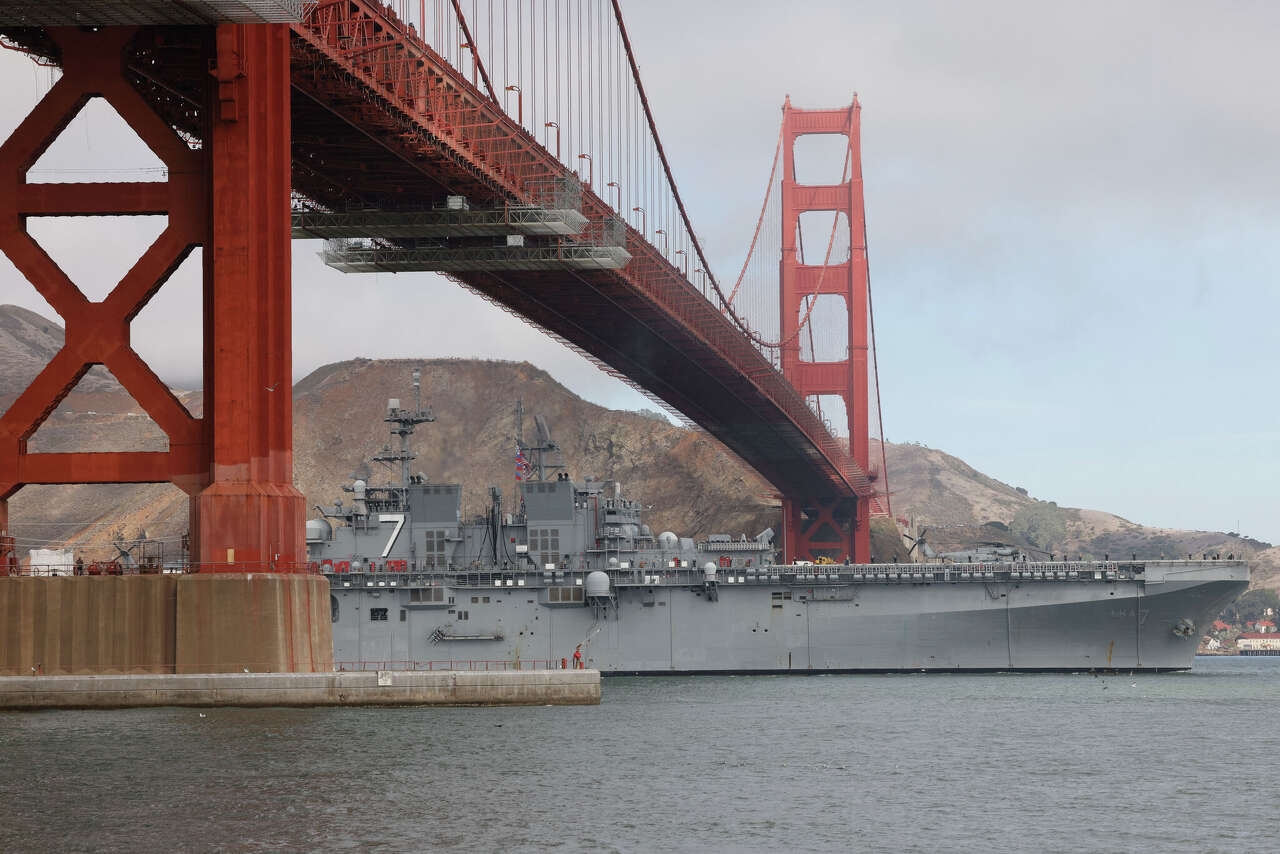
The resilience of the Golden Gate Bride partly comes from sheer strength. The south tower, on the San Francisco side, is described in the report as a "robust structural feature like no other" and is surrounded by a reinforced concrete protective shell up to 28 feet thick. It can withstand about 50,000 kips of force, or roughly 25,000 tons. In many cases, engineers found, a ship would crumple and absorb its own impact energy before it could seriously damage the structure.
The bridge also has geographic defenses.
The north tower, on the Marin side, is considered the most vulnerable point. While it lacks the south tower's thick protective barrier, shallow water surrounding the tower acts as a natural shield. Fully loaded ships sit deeper in the water and would likely run aground before colliding with the structure.
Instead, the main risk comes from lighter, partially loaded vessels that travel higher in the water and could hit the tower's steel legs. Even then, engineers said, the chance of a collapse remains extremely small.
While thousands of ships travel under the bridge in one of the busiest waterways in the United States, only 25 vessels large enough to cause damage pass under the bridge's massive 4,200-foot span each day on average, and large vessels rarely pass close to one another.
And unlike many ports, there is no defined navigation channel beneath the span. Still, ships tend to follow broad, predictable paths, which reduces the chance of a direct strike.
A catastrophic failure would require a rare chain of events. A ship would have to drift off course, plow through natural barriers and strike with enough strength.
Engineers say the probability of such a scenario is exceedingly small.
The bridge is also undergoing a major seismic retrofit, including $870 million worth of upgrades to both towers and spans at the structure's north and south ends.
Correction: A previous version of this story incorrectly described the status of vessel strike studies for the Antioch, Benicia-Martinez, Carquinez, Richmond-San Rafael and San Mateo-Hayward bridges. They were recently completed.
Subscribe
There’s more to San Francisco with the Chronicle. Subscribe today for just 25¢.Read this story on sfchronicle.com