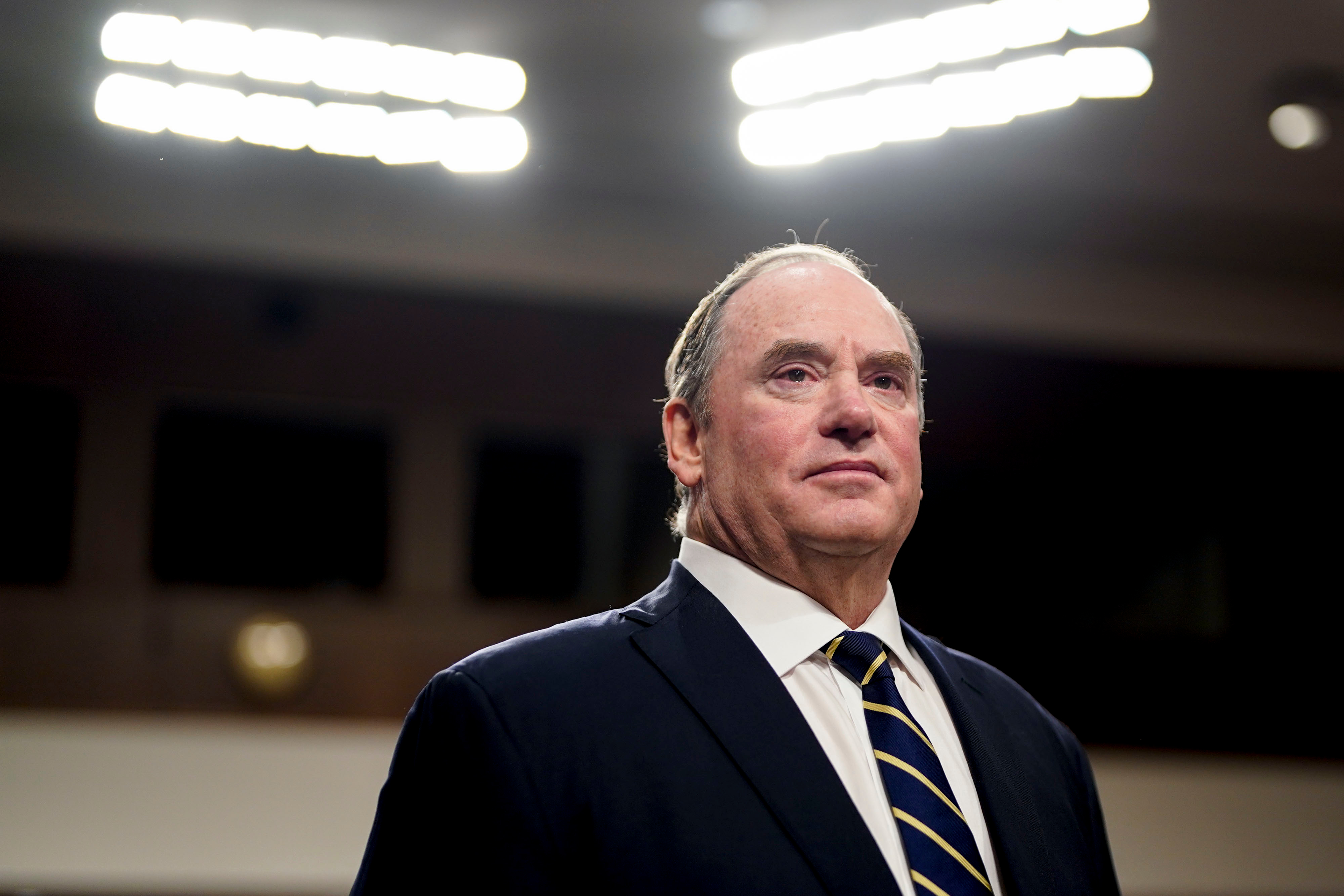
Navy Secretary John Phelan will depart the Trump administration “effective immediately,” officials said Wednesday evening, an abrupt exit after 13 tumultuous months at the Pentagon.
Sean Parnell, a spokesman for Defense Secretary Pete Hegseth, announced the news on social media, saying that Hegseth and Deputy Defense Secretary Steve Feinberg wished Phelan well.
Five officials said that Phelan, a billionaire art collector and fundraiser for President Donald Trump’s reelection campaign, was forced out after repeated clashes with both Hegseth and Feinberg over his management of shipbuilding and a variety of other issues. One administration official, who like some others spoke on the condition of anonymity because of the issue’s sensitivity, said Phelan was asked to step down.
Spokespeople for Hegseth and Feinberg did not respond to questions about the move. Spokespeople for Phelan and the White House referred questions back to Hegseth’s office.
Navy Undersecretary Hung Cao, a Navy veteran and former candidate for House and Senate seats in Virginia, will become the service’s acting secretary, Parnell said in his announcement. Hegseth has preferred Cao for the role for some time, officials said.
Phelan’s exit is the latest departure of a senior political appointee so far this year, after Trump, contrary to his first term as president, mostly resisted making such moves early on in this administration. Others who have been ousted or resigned under pressure since the beginning of March include Homeland Security Secretary Kristi L. Noem, Attorney General Pam Bondi, and Labor Secretary Lori Chavez-DeRemer.
Hegseth, by contrast, has overseen a near-continuous purge of the military’s most senior ranks. The high-profile ousters, often made with little public explanation, include the top generals and admirals of every branch of service except for the Marine Corps and Space Force, several military lawyers and even the head of the Army’s chaplain corps. A disproportionate number of those he’s removed are women and other minorities.
The disputes between Phelan, Hegseth and Feinberg are part of a broader pattern of infighting that has occurred during Hegseth’s tenure leading the Pentagon. The defense secretary also has clashed repeatedly with Army Secretary Dan Driscoll over Hegseth’s moves to fire some generals and block others from promotion.
Parnell, in a statement earlier this month, claimed that Hegseth “maintains excellent working relationships with the secretaries of every military service branch.” But numerous officials said that is not the case.
“They’ve been out to get Driscoll and Phelan for a long time now,” one U.S. official familiar with the issue said Wednesday night.
Phelan’s ouster was announced a day after the Navy unveiled an ambitious $377 billion budget request for next year that seeks more than $65.8 billion for shipbuilding, a 46 percent increase. The request would procure 18 new warships, including new submarines, destroyers, an amphibious assault ship and funds to get a “Trump Class” of battleship underway, a new class of warship announced by the president in December.
Phelan, though, had aggravated Hegseth over the way he was managing the Navy — in some cases taking matters directly to Trump due to their close relationship instead of going through the defense secretary, two U.S. officials said. He had sought to consolidate control of the service, which made it difficult for the Navy’s top admiral to perform his role independently, the officials said. Things came to a head with the unveiling of the battleship, which was not coordinated through Hegseth to the extent that the defense secretary had expected, the officials said.
“He got caught up in trying to do something big,” one person said.
Another source of disagreement between Hegseth and Phelan centered on Phelan’s initial chief of staff, Jon Harrison, and the manner in which he exercised his authority inside the Pentagon, officials familiar with the matter said.
Harrison was ousted by Hegseth in October, just after Cao was confirmed by the Senate as the service’s undersecretary. Cao supported the move, officials said.
Once Harrison was fired, it seemed like Phelan’s days were numbered, two U.S. officials said.
Harrison and Cao did not respond to requests for comment.
Even after months of internal tension, the timing of Phelan’s departure still managed to catch defense officials by surprise, those familiar with the matter said. Phelan, they noted, had visited Capitol Hill on Wednesday afternoon to meet with Republicans on the Senate Armed Services Committee, just hours before his departure was announced.
The administration had grown increasingly frustrated at the lack of progress from Phelan’s office in turning around the American shipbuilding industry, a priority of Trump’s, three U.S. officials said. One of them said that many of the Navy’s programs were behind schedule, and that Phelan had failed to make major changes or progress while in the role.
Feinberg had taken greater control over some shipbuilding programs, in an unusual sign of the Pentagon’s top leadership becoming directly involved in the service’s marquee purchases. There was a sense that Navy leadership was resisting the Trump administration’s intended direction for the service and that contributed to Phelan’s removal, the official said, noting that others should interpret the secretary’s removal as a warning.
Hunter Stires, who served as maritime strategist to Navy Secretary Carlos Del Toro during the Biden administration, said that Phelan committed a “grave strategic as well as political error” this week by signaling his openness to outsourcing production of the Navy’s warships to shipyards abroad.
“Everything’s on the table,” Phelan said during an appearance at the Sea-Air-Space conference outside Washington, according to the Navy Times. “We just need to look at it, understand it, understand the implications behind it and decide if we think that makes sense or not.”
Stires said the comments “directly undercut” a bipartisan strategy for shipbuilding championed by the Trump administration that aims to incentivize shipbuilders to invest in modernizing and expanding U.S. shipyards. Phelan’s exit, Stires said, “should be read as a stark and welcome signal that outsourcing U.S. naval construction is and must remain a nonstarter.”
There also was tension between Hegseth and Phelan after Hegseth directed the Navy secretary in December to determine whether Sen. Mark Kelly (D-Arizona), a retired Navy captain, should face repercussions for appearing in a video that advised service members of their duty not to follow illegal orders, officials familiar with the matter said.
Hegseth had Phelan review whether Kelly’s involvement in the video should merit any action by the Pentagon. Phelan provided his recommendation to Hegseth in mid-December, though the Navy did not disclose publicly what he advised. Hegseth later announced the Pentagon was escalating the review into a full command investigation, which was later blocked by a federal court. The Defense Department has said it intends to appeal the decision.
In a statement Wednesday evening, Sen. Jack Reed (Rhode Island), the top Democrat on the Senate Armed Services Committee, called Phelan’s departure “troubling.”
“I am concerned it is yet another example of the instability and dysfunction that have come to define the Department of Defense under President Trump and Secretary Hegseth,” Reed said, arguing that “this kind of disruption at the top sends the wrong signal to our sailors and Marines, to our allies, and to our adversaries.”
A spokesperson for Sen. Roger Wicker (Mississippi), the committee’s Republican chair, did not respond when contacted for comment.
Republicans in Congress in recent weeks have expressed frustration with infighting at the Pentagon, particularly the friction that’s been on public display between Hegseth and Driscoll over Hegseth’s decision this month to fire the Army chief of staff, Gen. Randy George. At a hearing last week, a number of GOP lawmakers appeared sympathetic and supportive of the Army secretary.
But overall, Republicans have mostly avoided directly criticizing Hegseth, who has managed to keep Trump’s confidence despite a number of missteps early in his tenure. He is due to appear before the House Armed Services Committee alongside Chairman of the Joint Chiefs Gen. Dan Caine next week in what may prove to be a test of his popularity among the GOP-led panel.
Most Read From The Washington Post
- Iran says it seized 2 ships in Strait of Hormuz, hours after Trump’s ceasefire extension
- Ukraine will get $105 billion loan after Hungary drops opposition, E.U. says
- Lebanon looks to Trump for ‘leverage over Israel’ with ceasefire set to expire
- Beijing tightens its grip on AI firms that try to shed their Chinese ties
- Trump extends ceasefire indefinitely as Iran says it won’t join talks now