King Charles III took a major gamble by indirectly challenging President Donald Trump’s past comments on a raft of issues, including NATO, to repeated standing ovations from both parties in Congress on Tuesday.
The British monarch, 77, cited NATO support in the aftermath of 9/11 through the war in Afghanistan and said the “same, unyielding resolve is needed for the defense of Ukraine.”
Charles also spoke about the NATO alliance at a state dinner on Tuesday night, saying in part that the ties “deepen our technological and military cooperation and ensure that together we can meet the challenges of an increasingly complex and contested world.”
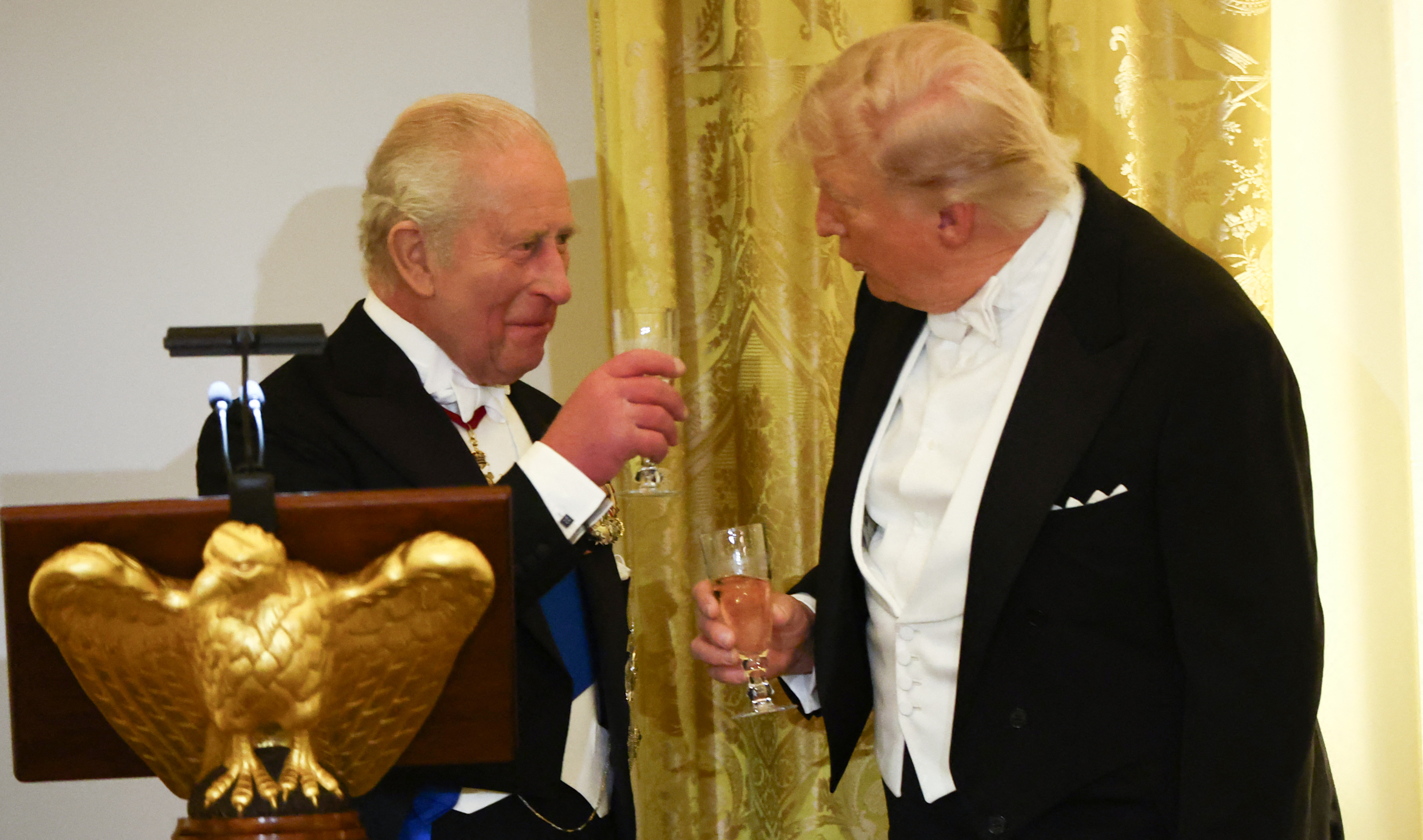
The king’s speech at the dinner was laced with numerous historical jokes about the White House, including a quip about the Boston Tea Party, which prompted Trump and the first lady to join in on the laughs.
Why It Matters
Royals are not supposed to be political but are generally afforded greater latitude when reflecting British foreign policy and Charles referenced numerous areas on which the president has been at loggerheads with British Prime Minister Keir Starmer in recent weeks.
The comments about NATO are particularly relevant because Trump was so explicit in calling the alliance a “paper tiger” and because he said NATO forces, which included the British military, “stayed a little back, a little off the front lines.”
King Charles’ Comments on NATO
“In the immediate aftermath of 9/11,” Charles said, “when NATO invoked Article 5 for the first time, and the United Nations Security Council was united in the face of terror, we answered the call together—as our people have done so for more than a century, shoulder to shoulder, through two World Wars, the Cold War, Afghanistan and moments that have defined our shared security.
“Today, Mr. Speaker, that same, unyielding resolve is needed for the defense of Ukraine and her most courageous people–it is needed in order to secure a truly just and lasting peace.
“From the depths of the Atlantic to the disastrously melting ice caps of the Arctic, the commitment and expertise of the United States Armed Forces and its allies lie at the heart of NATO, pledged to each other’s defense, protecting our citizens and interests, keeping North Americans and Europeans safe from our common adversaries.”
In particular, the king’s specific reference to standing “shoulder to shoulder” is a far cry from Trump’s account of NATO troops being “a little off the front lines.”
Elsewhere, the king acknowledged what he called “times of great uncertainty” as he thanked the American people and marked the upcoming 250th anniversary of U.S. independence from Britain during a rare address to Congress, emphasizing the enduring ties between the two nations amid political turmoil.
“For all that time,” Charles said, “our destinies have been interlinked.”
Charles is only the second British monarch to address a joint session of Congress. His mother, Queen Elizabeth II, delivered a speech to lawmakers in 1991 that focused on the historic relationship between the United States and the United Kingdom and their shared democratic values.
The king, who received several standing ovations, echoed those themes during his remarks Tuesday, delivered under sharply different circumstances. His address came as Trump is openly at odds with Starmer over the war in Iran and days after the White House Correspondents’ Dinner was disrupted by a shooting that authorities have described as an attempted assassination of Trump. Many members of Congress in attendance Tuesday had been at the dinner.
“Let me say with unshakeable resolve,” Charles said. “Such acts of violence will never succeed.”
King Charles Jokes About White House Renovations
During a state dinner alongside Queen Camilla, Melania Trump and Donald Trump on Tuesday night, Charles took a whimsical pass at the renovations to the East Wing.
“If I may say so, it is a particular pleasure to be back in this wonderful building, the heart of your democracy. On this occasion, I cannot help noticing the readjustments to the East Wing, Mr. President. Following your visit to Windsor Castle last year, and I’m sorry to say that we British of course made our own small attempt at real estate redevelopment of the White House in 1814,” Charles said.
The joke referenced a fire at the White House in 1814, set by the British, which prompted major renovation to the structure, the White House Historical Association notes.
Trump’s White House renovations in his second term have drawn national attention for their scale, cost and potential impact on the historic residence. His redesigns—from the Oval Office to the Rose Garden—along with the demolition of the East Wing to build a massive ballroom, have spurred debate over preservation, presidential authority and the role of private funding in altering federally protected landmarks.
Conversations regarding the ballroom’s construction were reignited this weekend after the shooting at the White House Correspondents’ Dinner in Washington, D.C.
King Charles Walks Halls of Congress With Mike Johnson
As is customary for a joint address, senators walked across the Capitol and entered the House chamber together, taking seats at the front of the room.
Military leaders were among those in attendance, seated near the rostrum where the king spoke. Lawmakers greeted one another across the aisle as they prepared to welcome the king, a rare bipartisan moment in the Capitol.
Charles arrived at the Capitol ahead of the address and met with congressional leaders. House Speaker Mike Johnson escorted the king through the Capitol to a reception room outside the House chamber before the joint session.
The king later met with other congressional leaders, including Senate Majority Leader John Thune of South Dakota, Senate Democratic Leader Chuck Schumer of New York and House Democratic Leader Hakeem Jeffries of New York.
At the start of the meeting, Johnson engaged the king in friendly conversation, appearing to explain aspects of the proceedings.
Watch King Charles’ Address to Congress
King Charles’ Subtle Reference to Jeffrey Epstein Victims
Charles made a reference to sexual abuse survivors but one so subtle that many may have simply missed it completely. In fact, he did not actually mention Jeffrey Epstein at all, nor sexual abuse directly.
“In both of our countries, it is the very fact of our vibrant, diverse and free societies that gives us our collective strength, including to support victims of some of the ills that, so tragically, exist in both our societies today,” the king said.
Charles in October stripped his brother, Andrew Mountbatten-Windsor, of his royal titles over his friendship with Epstein. Meanwhile, Epstein survivors have been calling for a meeting with the king and Camilla but palace insiders have always said it would not be possible.
A royal aide told Newsweek: “It was certainly in His Majesty’s mind to acknowledge victims of abuse, so they are naturally incorporated in this line.”
The reference would likely not have stood out for journalists, either, had Representative Ro Khanna, a California Democrat, not told Epstein survivors at a roundtable earlier in the day that the king would acknowledge them.
“I met with the British ambassador—the British ambassador has suggested that the king will acknowledge the Epstein survivors in his address to Congress today,” Khanna said, quoted by Politico. “I hope his flunkies don’t take out the acknowledgment from his text and I fully expect the king to be acknowledging the survivors—the Epstein survivors—in his speech to our nation and Congress this afternoon.”
Politico reported that he made the comments during a roundtable for Epstein victims.
Charles was also expected to express solidarity, sympathy and support in the aftermath of Saturday’s shooting, a palace source told Newsweek.
Why It Matters
Epstein survivors have been asking to meet with the king and queen during the visit, but the palace position has so far been that to do so would risk prejudicing the outcome of ongoing police investigations into Andrew Mountbatten-Windsor and former British Ambassador Peter Mandelson.
Police Investigation Into Andrew
Mountbatten-Windsor was arrested in February on suspicion of misconduct in a public office and released under investigation. He has not so far been charged and inquiries into reports he leaked confidential government documents to Epstein continue.
Separately, Virginia Giuffre accused Mountbatten-Windsor of sexual assault, saying in a lawsuit that she was flown at age 17 to London, New York and the U.S. Virgin Islands to have sex with him in 2001. Mountbatten-Windsor has always denied all Epstein related wrongdoing. Giuffre died by suicide last year.
Charles has released a public statement on Mountbatten-Windsor before, and in fact endorsed the police investigation at the time it was launched in mid-February.
Back then, Charles offered police “our full and wholehearted support and co-operation,” adding that “the law must take its course.”
That, however, was before Mountbatten-Windsor was arrested. That distinction is crucial because of British laws designed to protect court cases from undue influence from the point that proceedings become active, beginning with an arrest.
Mandelson was also arrested in February on suspicion of misconduct in a public office, again following reports that he leaked documents to Epstein. He also denies all wrongdoing.
Why Palace Ruled Out King and Queen Meeting Epstein Victims
A more explicit reference to Epstein in the speech would have posed questions about the explanation given for why Charles and Camilla could not sit down with the victims.
“It’s not that Their Majesties will not meet them, it’s that they cannot,” a palace source recently told Newsweek. “There is genuine jeopardy that anything that Their Majesties do or say on a State Visit will indicate a view on the matter and might prejudice the police action under way and therefore the result.”
Related Articles