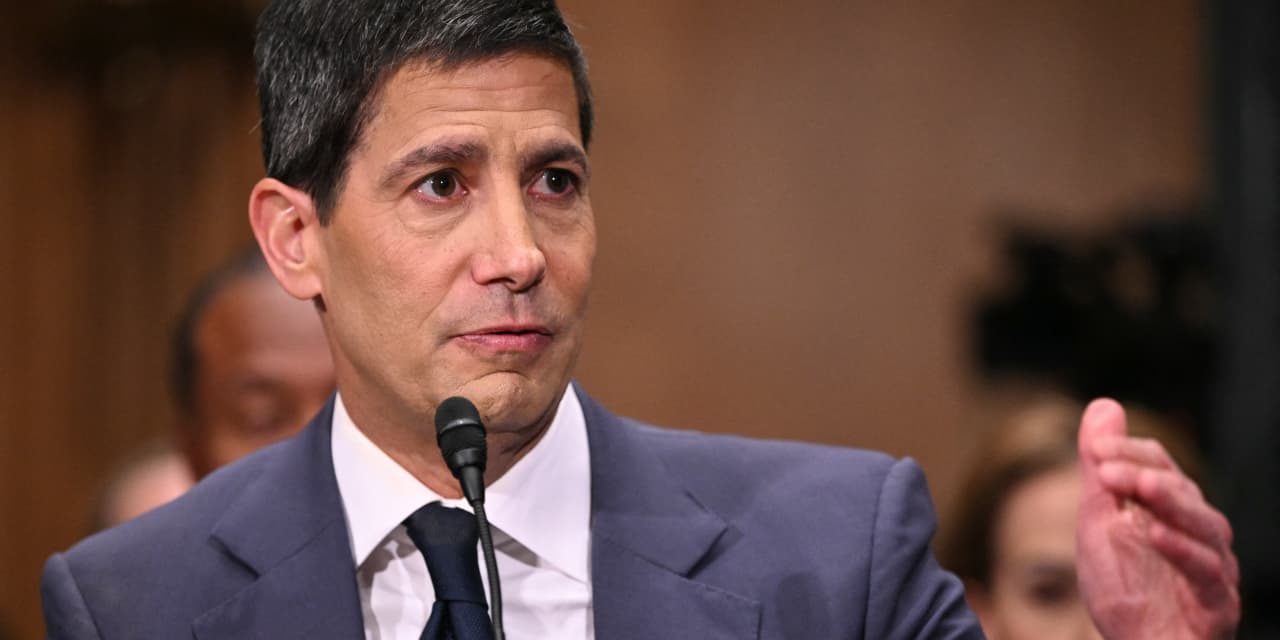
The bond market isn’t waiting around for Kevin Warsh, the newly confirmed head of the Federal Reserve, to get settled into his role at the helm of the U.S. central bank.
Yields across the roughly $30 trillion Treasury market already were repricing higher, raising interest rates, tightening financial conditions and increasing borrowing costs for the economy.
“Warsh wanted the option to cut on day one,” said Vincent Ahn, a portfolio manager at Wisdom Fixed Income Management. But the bond market just took that option off the table for him, he said.
The 30-year Treasury yield this week topped the 5% threshold, the benchmark 10-year yield topped 4.5% for the first time since June 2025 on Friday, and the policy-sensitive 2-year yield climbed above 4%, also for the first time in 11 months.
All three rates are important to the Fed, banks and borrowers. But the 2-year yield’s move above the Fed’s 3.7% upper limit of its target funding range is particularly noteworthy, as the below chart shows.
That’s because the 2-year Treasury yield usually doesn’t sit above the Fed’s short-term target range, a rate that influences overall borrowing conditions. What the new shift signals is that the Treasury yield curve is increasing rates, even before the first policy-setting meeting set for June 16-17 with Warsh serving as chair.
“This is the modern bond vigilante,” said Ahn. “They don’t burn down the Fed’s credibility with one yield spike. They starve its optionality by lifting the entire curve above the policy band.”
There has long been a perception that new Fed chairs are swiftly tested by turmoil in markets shortly after taking the reins, according to Deutsche Bank’s Jim Reid, who noted the actual data on the topic has been mixed.
The U.S. economy was in a recession when Arthur Burns took office in February 1970. Paul Volcker launched a campaign of rate hikes that led to a recession, and the Alan Greenspan era came on the heels of the Black Monday crash of 1987. Under Jerome Powell, the pandemic didn’t happen until two years into his leadership.
Warsh steps into Powell’s shoes with stocks at record highs, following their swift recovery from the initial shock of the still-unresolved Iran war. The Dow Jones Industrial Average reclaimed the 50,000 level Thursday, while the S&P 500 index was at 7,500 and the Nasdaq composite was around 26,640, according to FactSet.
President Donald Trump made no secret of his desire for rate cuts during Powell’s term as Fed chair, which just ended. Powell will be staying to serve as governor for a period of time, or at least until a Justice Department investigation into Powell regarding building renovations is “well and truly over, with transparency and finality.” Warsh has made the case for lower rates, even with inflation running hot.
See: 5 tests Kevin Warsh will face as Fed chair
The bond market seems to have other plans. Gas prices have eclipsed $4.50 a gallon in the wake of the Iran war, and the consumer-price index for April this week spooked investors by creeping up closer to 4% — and moving further away from the Fed’s 2% annual target.
Unlike the stock market’s run to fresh records, investors in bonds have been bracing for inflation problems to stick around because of the surge in oil, gas and diesel prices since the Iran conflict started in late February.
When Erik Aarts, a senior fixed-income strategist at Touchstone Investments, recently filled up during a trip in California, he ended up paying more than $6.50 a gallon for gas. “That was very painful,” he said. But it also reminded him that high gas prices can weigh on the economy, if they eventually keep households from spending elsewhere.
Many Americans don’t have transportation alternatives for work, which means they keep paying the extra cost of gas while they can, but it takes up more of their paycheck.
“To the extent the bar was high for a Fed rate hike, it’s coming down,” Aarts said.
The odds of Fed rate hikes by early December were close to 40% on Thursday, as opposed to around 60% for no change and less than 2% for a rate cut, according to the CME FedWatch Tool.
Still, there’s the largely frozen labor market to consider, albeit with an unemployment rate pegged at a fairly low 4.3% in April.
“The Fed really cares about the labor market,” said Brij Khurana, a fixed-income portfolio manager at Wellington Management. While stimulus and strong wage growth added to inflation in 2022, that’s isn’t the case now. There’s also the new worry about AI replacing white-collar jobs.
“We are almost living this minute-by-minute,” Khurana said. And with the Iran war, the longer the conflict goes on, “the growth hit becomes more substantial, in my mind, than an inflation hit.”
Joseph Adinolfi contributed