Since February 28, when the United States launched Operation Epic Fury against Iran, American forces have conducted an intense 39-day air and missile campaign, striking more than 13,000 targets before the current ceasefire, such as it is. According to the Center for Strategic and International Studies (CSIS), the US has fired a very significant proportion of its most advanced weapons.
Particularly alarming is the expenditure of defensive systems. The United States has fired roughly 50 per cent of its Patriot PAC-3 interceptor missile inventory – an estimated 1,060-1,430 missiles out of pre-war stocks. These are highly capable, able to bring down ballistic and even hypersonic weapons, but they cost around $4.2m (£3.3m) a shot. THAAD interceptors, at $12.7m (£10.0m) each, have been even more depleted: between 53 and 80 per cent of available stocks, or roughly 190-290 missiles, have been expended. All in, that’s between $7bn (£5.6bn) and $10bn (£8.0bn) worth of weapons gone just across these two systems alone. And they can only be replaced at a certain rate. I’ve long held a theory that every time one of these missiles is fired, someone in Beijing rings a bell. They ring it extra hard if a Patriot or a THAAD was fired against a $20,000 (£16,000) drone. Meanwhile, someone in US Pacific Command crosses them off a whiteboard whilst chuntering about how they really need them more.
At sea, the US Navy has emptied a lot of missile tubes, particularly in the Eastern Mediterranean in the early phases. CSIS suggests that 40 per cent of the SM-3 ballistic missile defence interceptors and over 45 per cent of the latest super-versatile SM-6 missiles from Aegis-equipped warships in theatre have been fired. SM-3s are eye-wateringly expensive at about $20m (£16m) a shot – understandably as they are space weapons carrying an “exo-atmospheric kill vehicle” rather than a normal warhead, which can take down a ballistic weapon (or a satellite) travelling outside the atmosphere.
SM-3s are only produced at a rate of 12 per year. Add the SM-6s, one of only a few weapons thought capable of stopping hypersonic threats, and the total cost is $7bn-$9bn (£5.6bn-£7.2bn).
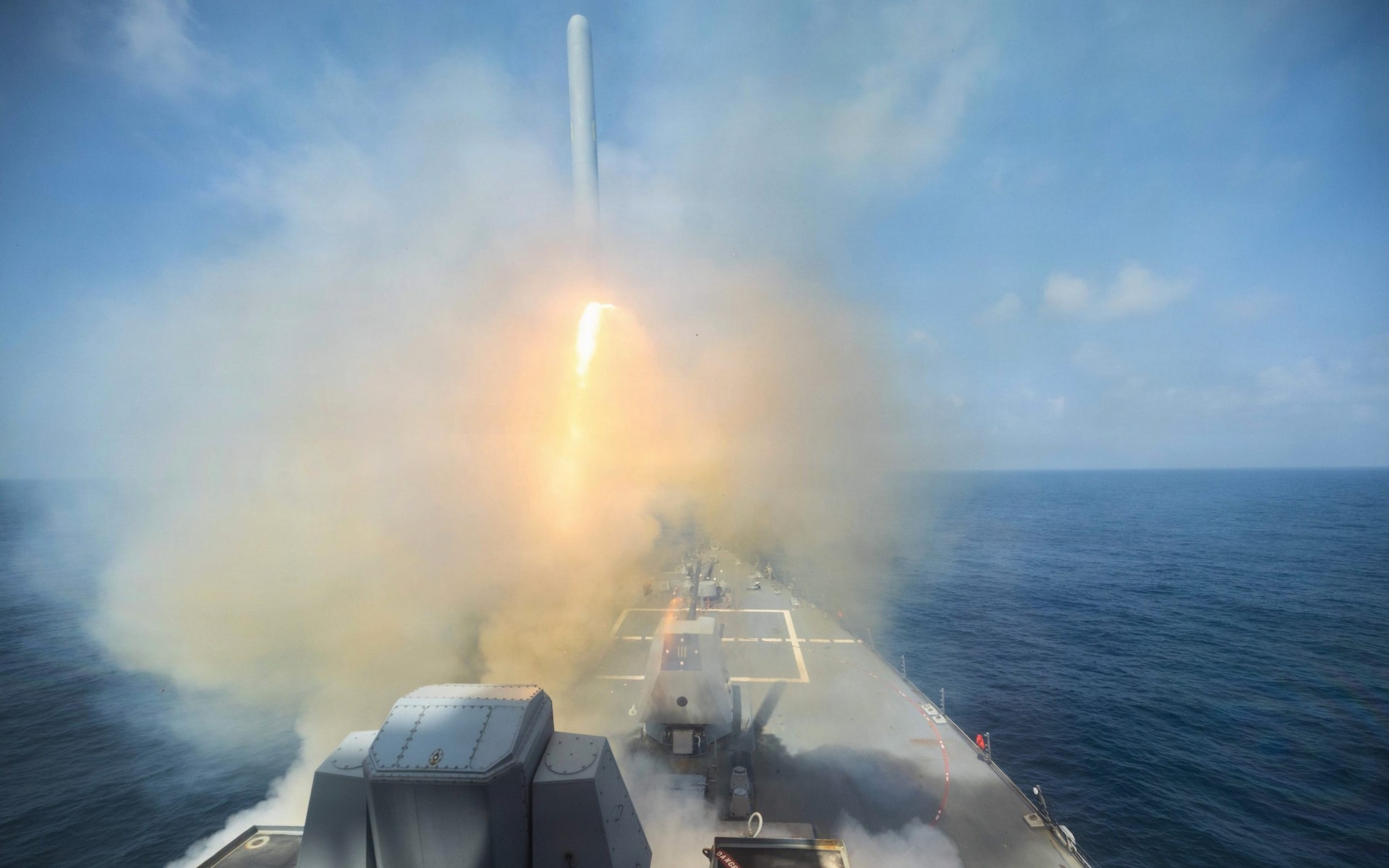
Offensive weapon stocks have been hit equally hard. According to CSIS, US naval forces alone have expended more than 1,000 Tomahawk Land Attack Missiles (TLAMs), accounting for perhaps a third or more of the total US inventory. Production has run at fewer than 60 Tomahawks per year in recent budgets, meaning that replenishment will take years even with hugely increased production.
Carrier-based F/A-18 Super Hornets, operating under conditions of air superiority, shifted later in the campaign to cheaper precision-guided munitions such as Joint Direct Attack Munitions (JDAMs) – smartbombs – and smaller, cheaper standoff weapons. However, Pentagon briefings reported in the Washington Post suggested that the early phase relied heavily on high-value air-launched systems such as the Joint Air-to-Surface Standoff Missile (JASSM), another flagship weapon, with significant impacts on finite stockpiles.
Even more eye-watering costs came from strategic platforms. According to the same CSIS assessment, B-2 Spirit bombers delivered Massive Ordnance Penetrators (GBU-57s) and other precision weapons against deeply buried nuclear and command targets. The GBU-57 is not particularly technologically sophisticated or expensive like a Tomahawk or a JASSM. It is essentially a massive steel pencil with a smartbomb’s warhead and guidance. Nonetheless, it isn’t cheap and the US does not have it in large numbers.
The raw materials underpinning these systems add another layer of strategic vulnerability. Modern precision weapons depend on rare earth elements – neodymium, praseodymium and dysprosium chief among them – for magnets in guidance systems, motors, sensors, chips and so on.
The United States produces very little of these substances domestically, though it could do so if the price went up. At the moment, needless to say, it’s China that controls roughly 70 per cent of global supplies. Tungsten, used in penetrators, alloys and high-temperature components, faces a similar squeeze. At a recent conference, someone who would know estimated that 65 tons of tungsten had been fired away in the Iran operations so far. That’s $17m (£13m) on its own, although again, availability is perhaps more important than cost. Replenishing both munitions and the minerals that make them is not just an industrial challenge; it is a global one.
As it has since February 28, the question hovers in the air: what has all this achieved? Tactical successes masquerading as operational objectives have been seen, including the destruction of Iran’s largely irrelevant regular navy and air force. Meanwhile, progress surrounding the big goals – regime, nuclear, proxies and freedom of navigation – is uncertain. The relentless positivity out of Washington has also worn off, perhaps encapsulated best by Monday’s Project Freedom making things considerably worse for 48 hours before being paused “at the request of Pakistan”. The US reaction to Iran’s strikes into various surrounding countries during Project Freedom was sufficiently dismissive to cause the Saudis to temporarily suspend US access, basing and overflight (ABO) from their main airbase.
Politics aside, the expensive defensive weapons continue to fly and the happy bells in Beijing keep ringing. Any attempt by the US to escalate again will need to have a clearer definition of success and some kind of stop line before the arsenals are all empty. America’s stocks are not yet exhausted, but there is no doubt that the margin for error in any future Pacific contingency has reduced. Rebuilding the stockpiles will take up to four years even assuming accelerated production, and much of that requires commodities that the US does not control.
When the dust has settled from all this, there will be some seismic lessons to be learnt. How did we set up a global logistics and shipping system that was so vulnerable to disruption by a single rogue country and what are the alternatives? The principle of Freedom of Navigation is being tested. Depending on the way this conflict ends, it may be disappearing into the past. Access, Basing and Overflight for US forces will be reviewed by everyone affected this time around. The other lesson from this (and the Red Sea and Black Sea before) is that if you fire $10m missiles to intercept $20,000 drones and $2m missiles to blow up jet-skis in someone’s garage, eventually you run out of missiles: even if you are the US.
We aren’t at that point. But we can say that the Americans have shot away an awful lot of their advanced hardware to achieve an inconclusive result against Iran, very much not one of its biggest enemies. The US is materially weaker as a result, and the way this has panned out does not bode well for any situation in which it is up against someone more serious.
For us in Britain and Europe, the lesson has been rammed home even harder. We absolutely must start arming ourselves properly to be safe in an increasingly dangerous world.
Tom Sharpe
I know the Strait of Hormuz well. Opening it will be an almighty struggle