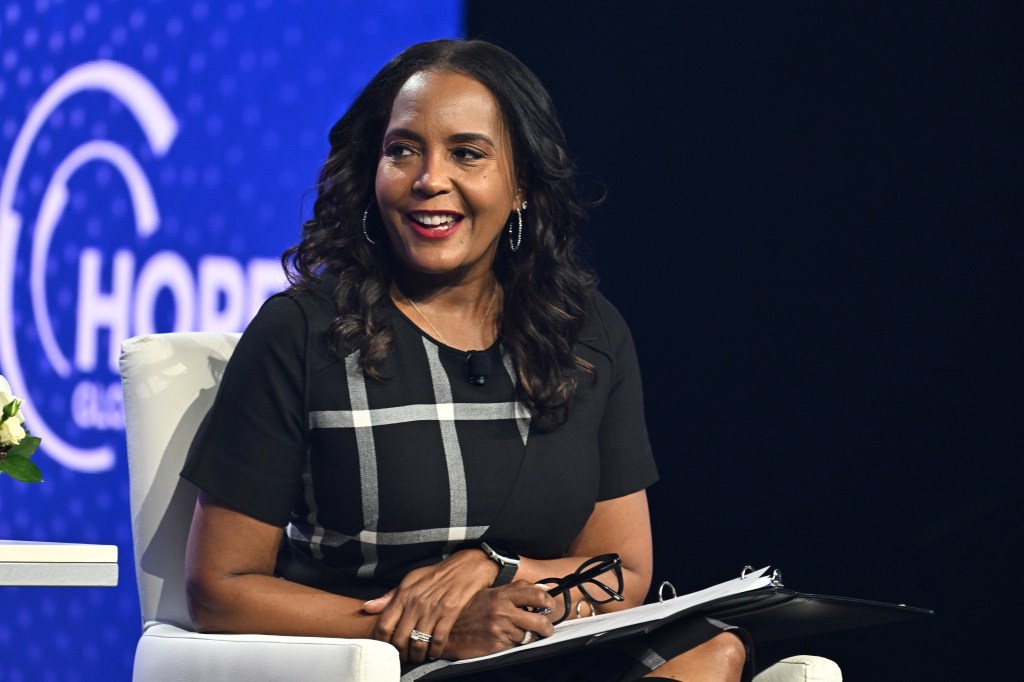
Republican candidates narrowly trailed former Atlanta Mayor Keisha Lance Bottoms, a Democrat, in the 2026 Georgia gubernatorial race, according to a new poll.
The new survey from the Republican-aligned Echelon Insights and NetChoice showed Bottoms with a single-digit lead over Lieutenant Governor Burt Jones, Secretary of State Brad Raffensperger, and health care executive Rick Jackson. GOP Governor Brian Kemp cannot run again because of term limits, leaving the race open in the battleground state roughly evenly divided between Democrats and Republicans.
Why It Matters
Georgia, once a more reliably Republican state, has shifted toward purple status over the past decade. It has become more willing to vote for Democrats in federal elections, electing senators Jon Ossoff and Raphael Warnock. It backed former President Joe Biden in 2020 but supported President Donald Trump in 2024.
The race is expected to be one of the most competitive of the 2026 midterm elections. Democrats are optimistic about their chances of having a strong year, as the party in the White House typically loses seats in the midterms—and Trump’s approval rating has declined since taking office. However, Republicans note that Georgia has retained its slight Republican lead in recent statewide races, having reelected Kemp by more than 7 points in 2022.
The Echelon poll is the first public survey of the general election in this race, providing an early glimpse of voter sentiment about the candidates.
Keisha Lance Bottoms Leads in Early Poll
Raffensperger, who rose to national prominence after Trump urged him to “find” 11,780 votes in the state following his 2020 loss, was the most competitive Republican. In that matchup, Bottoms held only a 2-point lead. Bottoms received support from 46 percent of respondents, while Raffensperger received 44 percent.
She held identical 6-point leads over Jackson and Jones, who has been endorsed by Trump. In both hypotheticals, Bottoms received 49 percent support to 43 percent for Jackson and Jones.
While Bottoms’ lead may be concerning for Republicans, the poll is still within the margin of error, suggesting that the race is likely to be close in November.
The poll surveyed 407 likely voters from April 3-9 and had a margin of error of plus or minus 6.5 percentage points.
Bottoms is well known among Georgia’s electorate and may be benefiting from high name recognition, as well as a more fragmented Republican primary. While she has name recognition from her time as mayor, she has not run statewide before. More polls released over the coming months could reveal how stable Bottoms’ lead may be.
Democrats have their best shot at winning a Georgia governor’s race in more 20 years, Jeffrey Lazarus, a political science professor at Georgia State University, told Newsweek.
“I think the race is going to be pretty close. Georgia is fundamentally a state with a slight Republican lean, but that advantage is getting smaller slowly over time. And evidence by the fact that we have two Democratic senators, Democrats can now win here with the right push,” he said.
Jackson and Jones have “cultivated extremely conservative images, and will pull exclusively from Republican and right-leaning independent voters,” but Raffensperger still has some crossover appeal, Lazarus said.
Rashad Taylor, Bottoms’ campaign manager, told Newsweek the campaign is “taking nothing for granted” and is “fully focused on winning the Democratic nomination.”
“On the Democratic side, it’s not clear to me that any candidate is significantly advantaged or disadvantaged in the general election. There is some residual resentment of Bottoms dating to her time as mayor of Atlanta, but my personal opinion is that those folks will fall in line if she becomes the nominee,” he said.
“We are running with the urgency and discipline of a campaign that is 20-points behind. What is encouraging is the momentum we are seeing on the ground, all across Georgia, from voters who want lower costs, more opportunity, and a governor who will stand up to the Trump Administration’s chaos and failed policies that have driven costs higher for Georgia families,” Taylor said.
Newsweek also reached out to the Jones, Raffensperger and Jackson campaigns for comment via email.
Prediction markets give Democrats a narrow advantage—Kalshi gave Democrats a 59 percent chance of winning the race as of Thursday morning. At the same time, Polymarket gave Democrats a 61 percent chance. These markets do not always accurately predict outcomes but reveal public sentiment about current events.
The Cook Political Report and Sabato’s Crystal Ball classify the race as a toss-up.
Bottoms Leads Democratic Primary, GOP is Divided—Polls
The latest Emerson College poll showed her with 35 percent support in the Democratic primary to 13 percent for former Lieutenant Governor Geoff Duncan, an ex-Republican, former DeKalb County CEO Michael Thurmond’s 7 percent and former state Senator Jason Esteves’ 4 percent.
At the same time, the poll showed a more divided Republican field.
Jones led with 21 percent, followed by Jackson at 20 percent and Raffensperger at 11 percent. Attorney General Chris Carr polled at 6 percent.
Emerson surveyed 1,000 Georgia voters from February 28-March 2 and had a margin of error of plus or minus 3 percent.
A separate poll conducted by 20/20 Insight showed Bottoms with 32 percent, followed by Esteves at 14 percent and Duncan at 12 percent. Thurmond received 11 percent support in that poll. It surveyed 575 likely voters from March 19-24 and had a margin of error of plus or minus 4.1 percentage points.
A Quantus Insights poll showed Jackson leading the GOP field with 33 percent to Jones’ 17 percent and Raffensperger’s 8 percent. It surveyed 1,337 likely voters from February 17-18 and had a margin of error of plus or minus 3 percentage points.
How Popular Is Donald Trump in Georgia?
Trump’s presidency will loom over the race, as Democrats across the country will aim to benefit from his dwindling approval nationwide. Democrats are banking on higher turnout, which has played out in recent special elections across the country. Greater Democratic motivation to vote in November would be a boon for Bottoms.
In Georgia, Trump’s approval stood at 42 percent in the Emerson poll, while slightly more than 51 percent said they disapprove of his job performance. That’s roughly in line with his national polling, per Emerson. Its latest national poll, March 16-17, showed 51 percent of Americans disapproving of his performance and 42 percent approving.
Trump’s approval could benefit Democrats in this race, Lazarus said.
“When people decide how to vote for national offices, they’re thinking about how they feel about Trump. Trump’s not exceptionally popular (that was true even before his polling cratered in the past year), so that gives Democrats a bit of an advantage. And that national-level advantage doesn’t necessarily hold in state races,” he said.
The poll comes after Democrats overperformed in the Georgia special election to replace former Representative Marjorie Taylor Greene, a Republican who resigned from Congress earlier this year. Republican Clay Fuller won the April 7 special election by about 11 points in the deep-red district, a significant narrowing compared to Trump’s 37-point victory in the district in 2024.
Greene told Politico in April that Republicans should be concerned about those results.
“If you saw a big drop in my district for Republican votes, a drastic drop like that, that could very much affect the governor’s race, lieutenant governor, secretary of state and of course Jon Ossoff’s Senate seat that’s up for reelection in 2026,” she said. “That’s what I saw right away, and of course it matches what we’re seeing nationwide.”
Georgia’s Shift From Red to Purple
Georgia has shifted from a reliably Republican state into a true swing state over the last two decades, driven largely by rapid growth and demographic change in Atlanta and its surrounding suburbs.
Trump carried Georgia by about 2.2 points in the 2024 presidential election, after Joe Biden won the state by roughly 0.2 points in 2020. Trump won Georgia by about 5 points in 2016, while Mitt Romney won it by roughly 8 points in 2012 and John McCain by about 5 points in 2008.
When Is the Georgia Election?
Democrats and Republicans will select their nominees in the primaries on May 19, with a June 16 runoff scheduled if no candidate wins a majority.
Update 04/23/26, 5:19 p.m.: This article has been updated with comment from Bottoms’ campaign.
Related Articles