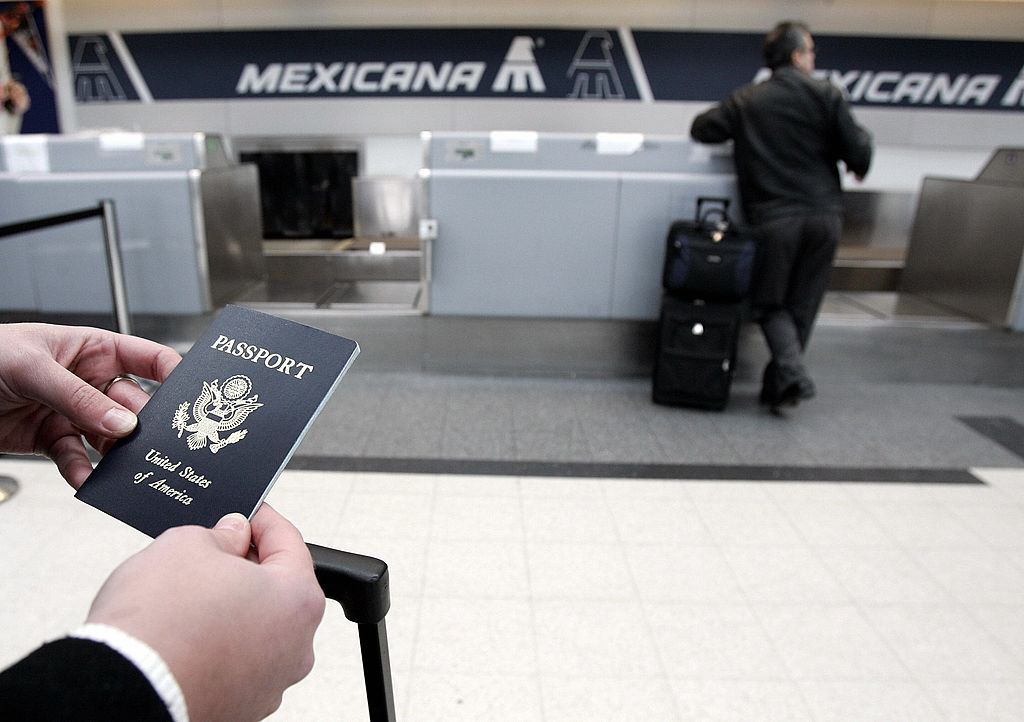
The Trump administration will start revoking passports of Americans who owe child support in excess of $100,000, which would apply to around 2,700 people, according to the Associated Press (AP).
The State Department on Thursday posted a statement on its website announcing plans to enact “unprecedented” coordination with the Department of Health and Human Services (HHS) to “revoke passports of Americans who have racked up significant outstanding child support debt.”
The scale of debt that will trigger revocation is still under consideration, the AP reported, and the program could soon lower its threshold to $2,500 in unpaid child support. The revocations are set to begin Friday.
The number of Americans affected by that lower threshold remains to be seen, however, as HHS continues to collect data from state agencies responsible for tracking those figures.
Those whose passports are revoked under the program will be notified that they will not be able to use their documents for travel and must apply for a new passport once their arrears are confirmed as paid.
The State Department stresses the initiative as a means of “putting American families first through our passport process.”
“This action supports the welfare of American children by exacting real consequences for child support delinquency under existing federal law,” the department wrote.
The department noted on X Thursday that those with significant debt who are outside the U.S. and have had their passports revoked are eligible only for a limited-validity passport, “for direct return to the United States.”
Who Is at Risk of Losing a Passport?
Reports that the Trump administration was considering this initiative first emerged in February, noting that it relied on a little-known 1996 law that allows the State Department to revoke passports for unpaid child support exceeding $2,500, though the tool has rarely been used. Enforcement was generally only enacted when a parent approached a U.S. consulate or embassy for support.
Assistant Secretary of State for Consular Affairs Mora Namdar told the AP that those who lose their passports can regain them once they “resolve their debts.”
“We are expanding a commonsense practice that has been proven effective at getting those who owe child support to pay their debt,” Namdar said.
The State Department also told the AP that since reports broke in February about the expanded plan, “hundreds of parents took action and resolved their arrears with state authorities.” The department has not yet made clear whether this is a universal policy or whether certain exemptions will be allowed based on circumstances.
Connie Chesnik, president of the Virginia-based National Child Support Engagement Association, told Newsweek in an email statement that the process, as it currently exists, allows for revocation but was “cumbersome and not utilized by many states.”
“States more routinely utilize the passport denial provisions in current law to seek the denial of initial applications for new passports and the denial of applications for renewal of existing passports when a payer meets the criteria for denial,” she said.
How Much Child Support Is Paid Each Year?
According to census data, in 2022, about 4.7 million custodial parents with legal or informal child support agreements were expected to receive, on average, $6,400 annually—or about $530 per month.
The median amount of child support paid in 2022 was approximately $4,800. Custodial parents were supposed to collectively receive around $29.9 billion in child support payments but only received around $19.2 billion. Of that, 16.2 billion of an expected $25.2 billion went to mothers and $3 billion of an expected $4.8 billion went to fathers.
Since 1998, the State Department, through its enforcement against issuing passports, spurred repayment of $657 million in arrears, with $156 million of that sum paid over the past five years.
How Can I Renew My Passport?
Passports can be renewed online through the State Department website, which calls it the “only official, authorized place to renew your U.S. passport online.”
“Other websites or companies claiming to renew your passport online may be fraudulent. No one else can legally sign and submit your online passport application for you,” the department says on its website.
Before renewing your passport, you must ensure that:
- Your previous passport is or was valid for 10 years.
- Your previous passport expired less than five years ago or will expire in the next year.
- You are age 25 or older.
- You are not changing personal information, like name or sex.
- You do not plan to travel within six weeks of the renewal submission date.
- You are within a U.S. state or territory at the time of submission.
- You have your passport with you, and it is not damaged or mutilated.
Renewing a full passport book costs $130, while a passport card costs $30. You must submit a new photo with your application.
Online application is only for renewing the same type of document. If you plan to change from a passport book to a card or vice versa, it requires a mail-in application.
When Will Trump Passports Be Released?
The State Department is finalizing plans to include President Donald Trump’s portrait on new passports, marking the first time a sitting president has been featured on official travel documents.
The new passport design features Trump on the inside cover to commemorate the 250th anniversary of U.S. independence, featuring “customized artwork and enhanced imagery while maintaining the same security features that make the U.S. passport the most secure documents in the world,” a State Department spokesperson previously told Newsweek.
The passports will be issued as part of a “limited run” of 25,000 to 30,000, with the first books expected to be printed in July. The specialized passport will only be available to in-person applicants at the Washington Passport Agency, according to NPR.
Who Owes Child Support? 2023 Data Shows Stark Racial and Economic Divides
Census Bureau data from 2023 shows that child support debt in the United States falls unevenly across racial and socioeconomic lines, with Black custodial families disproportionately affected and millions of parents receiving only a fraction of what they are owed.
About 5.4 million parents were owed child support in 2017, but they received only 62% of the money due on average. The median amount actually received was $1,800, and 30% of custodial parents—roughly 1.6 million people—received nothing. Only 46% of parents with child support agreements received the full amount owed.
The demographics reveal sharp disparities. Black children are more than twice as likely as white, non‑Hispanic children to live with a single custodial parent—49% compared with 22%. Yet Black custodial parents are less likely to have formal child support orders: 40% compared with 57% of white custodial parents.
Researchers point to several structural factors. A disproportionately high share of Black men are incarcerated, and more than half of incarcerated people are parents. Many enter prison with existing child support orders, and their debt continues to accrue while they are unable to earn income. Upon release, incarcerated parents owe an average of more than $20,000 in child support debt, making repayment difficult and enforcement uneven.
Age, education, and family structure also shape outcomes. Custodial parents 40 and older, those with a bachelor’s degree, and parents who share custody are more likely to receive full payments. Parents who maintain contact between the child and the noncustodial parent are also more likely to receive the full amount.
Despite these disparities, the number of parents owed child support has declined over the past two decades, falling from 7.3 million in 2003 to 5.4 million in 2017, a 26% drop.
Child support remains a critical financial lifeline: about 1 in 5 U.S. children live in households receiving payments.
Related Articles