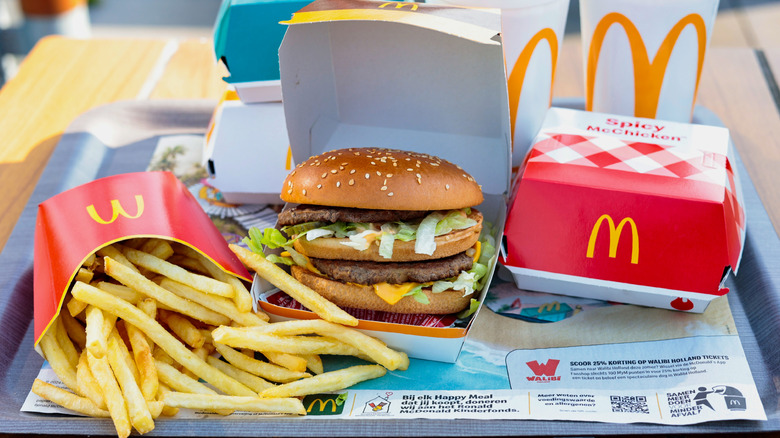
McDonald's is the uncontested leader of the fast food industry, but that doesn't mean it has the best reputation. The chain is frequently criticized for the quality of its food, which has been characterized as ultra-processed and packed with mystery chemicals and additives. Intensifying these claims is the unusual observation that its food doesn't seem to rot, even after sitting out for multiple days. Understandably, this has led to a wide range of conspiracy theories emerging online.
Back in 2020, for example, a man named David Whipple unveiled a 20-year-old hamburger he had bought in 1999. You'd expect it to have turned to dust by this point, but, shockingly, both the patty and bun were visually unchanged, with only the pickle having decomposed. Pretty weird, right? Typically, beef lasts only a few days in the refrigerator, and even in the freezer, it will eventually spoil. This has led many to claim that McDonald's had loaded its patties with unnatural preservatives.
However, there might be another reason the burgers don't rot. In response to the speculation, McDonald's released a statement classifying it as a myth. "In the right environment, our burgers, like most other foods, could decompose," it stated. Essentially, its patties lose a significant amount of moisture during the high-heat cooking process. If left in a dry environment, the burger continues to dehydrate so quickly that it effectively mummifies before mold or bacteria have the chance to grow. The chain also claimed that none of its patties contain any added preservatives or fillers.
Read more: 13 McDonald's Hacks That Will Change The Way You Eat At The Fast Food Chain
Proper storage and dehydration help prevent typical food decomposition
While the fact that McDonald's burgers don't seem to decompose can be unnerving, dehydration is actually a very natural process that has been used by humans as a preservation method for thousands of years. Think of beef jerky or biltong, for example. You wouldn't think twice about eating these, but they've essentially undergone the same process as an old McDonald's burger. You can make homemade jerky by slicing lean, raw beef into thin strips, then dehydrating it at a low heat for several hours. This process removes moisture to inhibit bacterial growth, making it shelf-stable and allowing it to last several years if properly stored.
McDonald's has also stated that salt and pepper are the only seasonings added to its burger patties, which might play a small role in how long they appear to last. As a natural preservative, salt can draw out moisture and slow bacterial growth. This could contribute to the patties rapidly drying out before bacteria has had a chance to set in.
Of course, how you store the burger makes all the difference. David Whipple had kept his burger sealed inside a Big Mac tin for two decades, only taking it out for the first time on camera. In that kind of environment, it was cut off from moisture, oxygen, and light — factors that contribute to food spoilage. This is why it's always best to store your food covered. The same applies to other dehydrated meats like jerky or biltong, and once they're taken out of protective packaging, their shelf life is immediately reduced.
Want more food knowledge? Sign up to our free newsletter where we're helping thousands of foodies, like you, become culinary masters, one email at a time. You can also add us as a preferred search source on Google.
Read the original article on Food Republic.