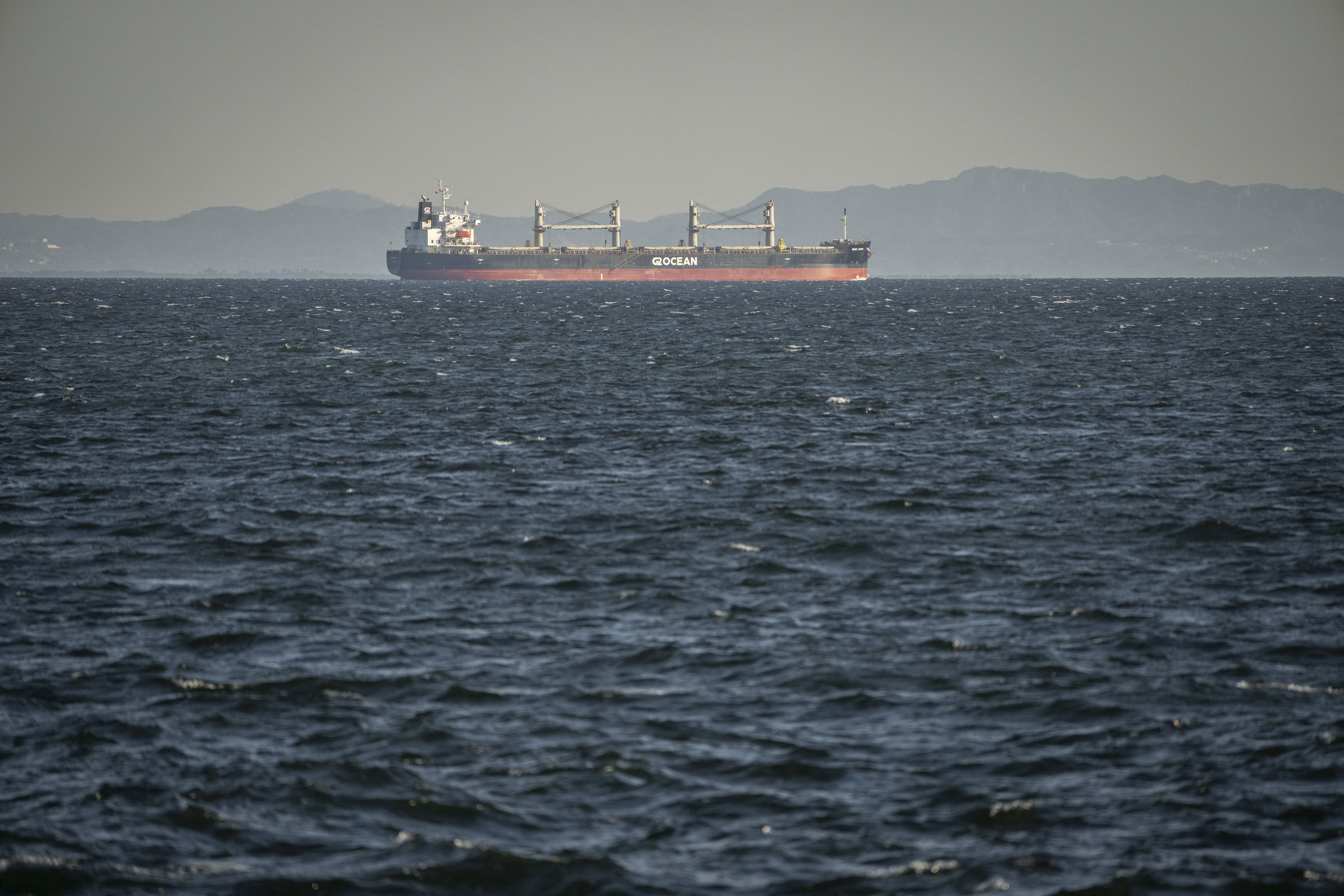
A Japanese-owned oil tanker has exited the Strait of Hormuz for the first time since the Iran war began, according to Tokyo and Tehran, potentially offering much-needed relief to a key U.S. ally hit hard by global energy disruptions.
The Panamanian-flagged very large crude carrier Idemitsu Maru, managed by a unit of the Japanese refiner Idemitsu Kosan, reached the Gulf of Oman in the early hours of Wednesday carrying 2 million barrels of Saudi crude, according to the tracking service MarineTraffic.
Japanese Prime Minister Sanae Takaichi said three Japanese crew members were on the Idemitsu Maru, which is expected to reach its reported destination of Nagoya by mid-May.
“Our country has, to date, made representations to Iran on every possible occasion, from the standpoint that it is important to ensure the early restoration of free and safe navigation through the Strait of Hormuz for vessels of all countries, including Japan,” she said.
Before Iran shut the strait to commercial traffic in response to the U.S. and Israeli attacks that began on February 28, Japan imported over 90 percent of its crude from the Middle East, most of it through the strait.
Cargo ships and tankers linked to China, India, Pakistan, France and Turkey are among those to have exited the strait since the war began, although there did not appear to be a fixed agreement with Iran behind each one.
The transit of the Idemitsu Maru, which was stranded in the Persian Gulf for two months, was the subject of intensive negotiations between Tokyo and Tehran, according to the Japanese press.
The Tasnim state news agency, linked to Iran’s Revolutionary Guard (IRGC), said on Wednesday that the tanker was let through with Iranian approval.
Unnamed Japanese officials told Japan’s Nikkei newspaper and the public broadcaster NHK that no transit fees were paid, although the ship did appear to utilize an IRGC-designated outbound sea lane near Iran’s Larak Island, according to Newsweek’s review of publicly available automatic identification system data.
The U.S. Treasury Department, in announcing another round of sanctions against Iran’s illicit oil trade on Tuesday, said that “toll” payments to Tehran were a sanctionable offense under the global U.S. financial control regime.
It was unclear whether the U.S. government was aware of the negotiations between Japan and Iran. The State Department did not immediately respond to a request for comment outside of office hours.
Shipowner Idemitsu Kosan couldn’t be reached for comment after hours but told the FNN Prime news website earlier on Wednesday that it couldn’t comment on individual vessels “for safety reasons.”
The Idemitsu Maru had passed the U.S. blockade line against Iran and was in the northern Arabian Sea as of 5 a.m. Eastern Time, according to AIS signals captured by MarineTraffic.
Tokyo said around 40 Japanese-linked ships were still stuck in the Gulf—a result of cautious shipping lines and costly war risk insurance amid the IRGC’s continued closure of the strait to most nations.
The Foreign Ministry in Tokyo said in a statement: “The Government of Japan considers this passage of a Japan-related vessel as a positive development, including from the perspective of protection of Japanese Nationals.”
The Japanese government released 30 days’ worth of strategic oil reserves in March and is on the verge of a 20-day drawdown planned for May 1. Oil-related industries have reported shortages in crude-derived products including paint thinner in recent days.
Japan Seeks Alternate Energy Sources
The Idemitsu Maru’s journey through the sensitive Strait of Hormuz would’ve been fraught with uncertainty, with the energy chokepoint having been opened and closed at different times amid stop-start negotiations between Iran and the United States.
Having reached Saudi Arabia’s Ras Tanura oil terminal on the eve of the conflict and loaded crude in early March, the laden tanker then spent weeks waiting in the Gulf off the coast of Abu Dhabi, despite a ceasefire that many thought would encourage more traffic through the strait.
The vessel did not begin its outbound voyage until late on Monday. When it reaches Japanese waters next month, it is certain to generate the same amount of media interest as did the Greek tanker Otis, which on Monday delivered Japan’s first oil shipment since the war began: 910,000 barrels of U.S. crude rerouted through the Panama Canal.
Takaichi said her government was securing around 60 percent of Japan’s crude oil needs in May from sources that bypass the Strait of Hormuz. Most of the shortfall is expected to be covered by U.S. imports.
In early April, the liquefied natural gas carrier Sohar LNG and the liquefied petroleum gas carries Green Sanvi and Green Asha—all owned or co-owned by Japan’s Mitsui O.S.K. Lines—were the only other Japanese-linked tankers known to have exited the strait, but none delivered product to Japan.
Hidenori Watanave, a professor of information studies at the University of Tokyo who followed the Idemitsu Maru’s transit, said the case had “symbolic significance.”
Watanave told Newsweek: “Idemitsu has a long historical relationship with Iran, most notably the 1953 Nissho Maru incident, when Idemitsu transported Iranian crude oil to Japan under intense international pressure.”
“After the Idemitsu Maru’s passage, the Iranian Embassy in Japan also referred to this history. It is not clear how much this historical background affected operational decisions, but it is clear that it still carries meaning in the diplomatic context of Japan-Iran relations,” he said.
“The Idemitsu Maru case is an important precedent, but it does not yet indicate a general reopening of the route. It shows that selective passage is possible, but I would not say that Japan’s energy shipping routes through Hormuz have returned to normal,” Watanave said.
Trump Heaps Pressure on Iran
On Tuesday, the U.S. military said it boarded another civilian vessel, the container ship Blue Star III, as part of its naval blockade against Iran, but later released it “after conducting a search and confirming the ship’s voyage would not include an Iranian port call.”
The vessel was sailing under the flag of Comoros and had just departed Pakistan’s Gwandar port at the time, ship-tracking data showed.
Warships of the 5th Fleet have been given sweeping authority by the U.S. Central Command to interdict vessels in open water, far beyond the stated blockade area, if they are suspected of transporting contraband, including fissile material and oil, to and from Iranian ports.
The expanded operation—designed to disrupt Iran’s energy trade and reduced its profits—appears to be working, but observers are skeptical about its compliance with international law on military conflict.
President Donald Trump agreed last week to extend the two-week ceasefire with Iran but refused to lift the blockade, which seeks to compel the Iranian leadership to sue for peace.
“Iran has just informed us that they are in a ‘State of Collapse’. They want us to ‘Open the Hormuz Strait,’ as soon as possible, as they try to figure out their leadership situation (Which I believe they will be able to do!),” Trump said in a Truth Social post on Tuesday.
Commodities analysts at Kpler said this week that Iran was weeks away from filling its available crude storage capacity and was already throttling production. Three to four months from now, with Iranian oil exports more than halved, it could lose $200-250 million a day in lost sales to China.
Related Articles