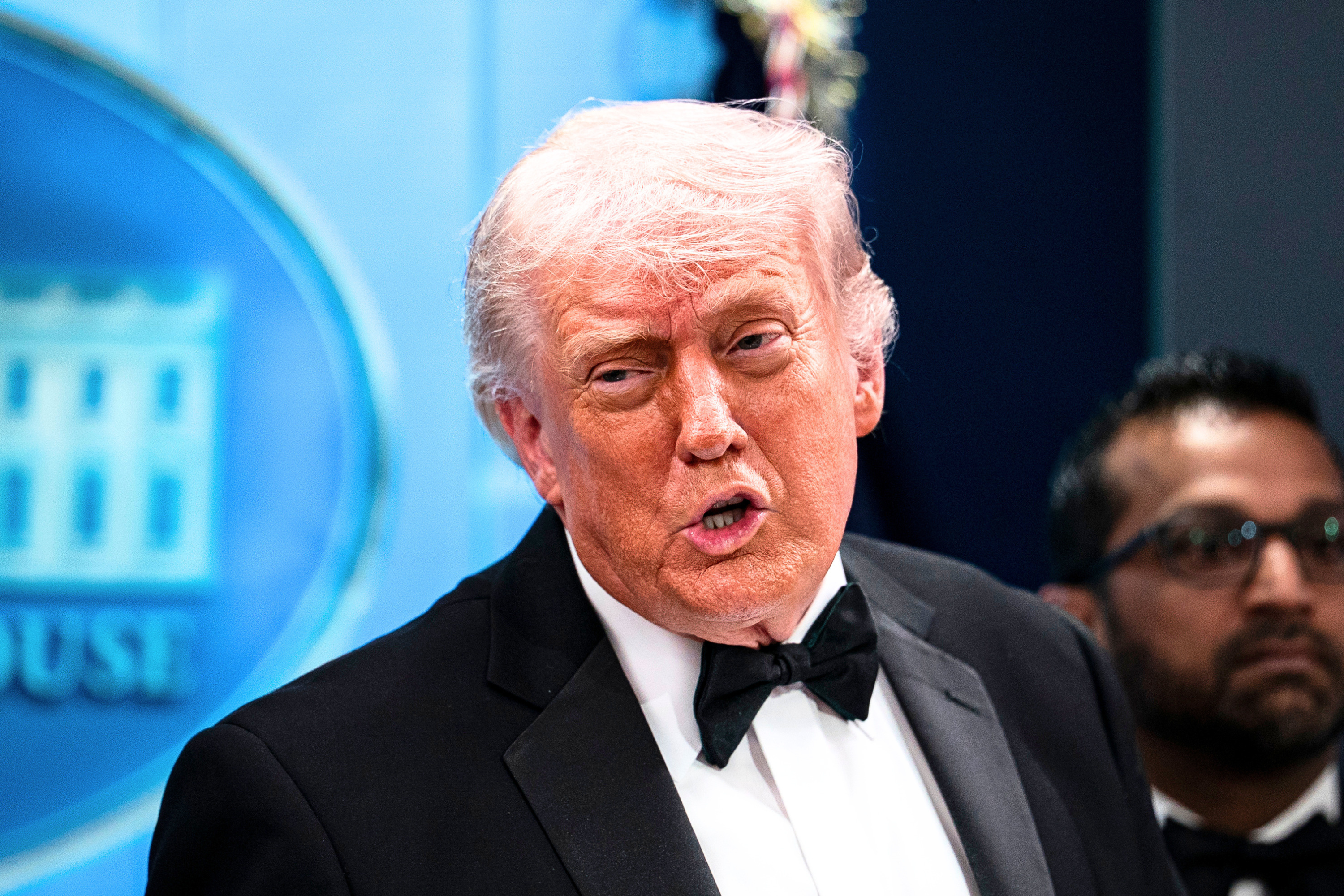
President Donald Trump’s approval rating has shown late-April movement in the wake of a shooting connected to a White House dinner, according to national opinion polls.
Early post‑incident polling from InsiderAdvantage and tracking data from Rasmussen Reports offer insight into whether the episode altered public views of Trump during an already strained political moment.
Short‑term events do not always translate into lasting shifts in approval, but moments involving political violence often test whether presidents benefit from what analysts call “rally‑around‑the‑flag” impacts.
‘Short-lived Bump’
“There’s good reason to think the assassination attempt could give Trump a short‑lived bump in the polls,” Thomas Gift, an associate professor in the UCL Department of Political Science and School of Public Policy, told Newsweek in emailed comments this week.
“Americans often respond sympathetically when a president confronts tragedy—or even a would‑be tragedy—and political science has long documented these kinds of effects, though they are usually modest and fleeting.” But the political expert added that any potential rally effect may struggle against broader forces shaping Trump’s approval trajectory.
“Any boost is unlikely to overwhelm broader structural pressures,” he said, pointing to persistent inflation and political fallout from the Iran war as ongoing drags on public support.
Why It Matters
Presidential approval ratings are a key measure of political strength, particularly after crises that test leadership and public confidence.
Even modest movement can signal how voters are interpreting events—and how durable those reactions may be.
Approval trends shape Trump’s political leverage, influence elite behavior in Washington, and help determine how resilient his support may be heading into future flashpoints.
What To Know
National polling conducted after April 26 shows Trump’s approval rating remaining underwater, with disapproval consistently outpacing approval, though the size of that gap varies by pollster and methodology.
One of the clearest changes appears in a new InsiderAdvantage national survey conducted April 26–27 among 800 likely voters. The mixed‑mode poll, which combined text messaging and online panel responses, was weighted for age, race, gender, and political affiliation and had a margin of error of plus or minus 3.46 percentage points.
That survey found 44 percent of respondents approving of Trump’s job performance and 49 percent disapproving, a net approval (those who approve minus those who disapprove) of -5.
In InsiderAdvantage’s previous poll, conducted between February 17-18, Trump stood at 50 percent approval and 46 percent disapproval, or net +4.
The nine‑point swing between the two polls represents a substantial shift over a short period, larger than would typically be attributed to random sampling variation alone.
Daily tracking data from Rasmussen Reports presents a steadier picture, though one that reinforces the broader finding of net‑negative approval.
Rasmussen’s Presidential Tracking Poll for Thursday, April 30 shows 45 percent of likely U.S. voters approving of Trump’s job performance and 54 percent disapproving, a net –9.
The April 30 result is broadly consistent with April 29, when Trump registered 45 percent approval and 53 percent disapproval, and marks a slight improvement from April 24’s 44–54 reading.
Rasmussen’s tracking poll is based on telephone interviews with roughly 300 likely voters per night, reported as a five‑day rolling average.
Structural Challenges For Trump
To reach voters without landlines, the pollster supplements phone interviews with responses collected via an online survey panel. For the full five‑day sample of 1,500 likely voters, the reported margin of sampling error is plus or minus 2.5 percentage points at the 95 percent confidence level.
Beyond the headline numbers, Rasmussen’s intensity data underscores a key structural challenge for Trump.
In the April 30 survey, 29 percent of respondents said they strongly approve of the job he is doing, while 46 percent strongly disapprove.
That imbalance produced a Presidential Approval Index of -17, suggesting that opposition remains not only larger than support but also more deeply held.
Taken together, the April polling suggests that while Trump’s approval remains fluid, the underlying environment is an unfavorable one.
Approval sits in the mid‑40s, disapproval in the low‑to‑mid‑50s, and intensity continues to skew sharply negative.
These latest late‑April polls suggest short‑term volatility rather than a genuine turnaround, with any movement occurring against the backdrop of consistently net‑negative approval.
What Polling Aggregates Say
Polling averages, which smooth out the ups and downs of individual surveys, reinforce the same basic picture emerging from late‑April polling: Trump remains deeply underwater nationally.
CNN’s Poll of Polls, which averages recent national surveys of U.S. adults that meet its editorial standards, shows Trump at 36 percent approval and 63 percent disapproval across polls conducted between April 8 and April 27.
The aggregate draws on results from major firms, including Reuters/Ipsos, AP‑NORC, Marquette Law School, CBS News/YouGov, and Strength In Numbers/Verasight. Because it combines multiple surveys rather than reporting a single sample, the Poll of Polls does not carry a margin of error.
Trump Still in Net Negative Overall
A similar story appears in the Silver Bulletin average, which puts Trump at roughly 39 percent approval and 57 percent disapproval as of its April 29 update.
Unlike a straight average, Silver Bulletin’s model weights polls by recency, sample quality, and pollster performance, while also adjusting for persistent house effects—an approach designed to reduce distortion from outlier polls or firms that survey unusually often.
The New York Times’ polling tracker lands in much the same place, showing Trump at about 39 percent approval and 58 percent disapproval around the same time.
Its model-based average uses weighted national polls and recency-based smoothing to estimate where public opinion is clustering rather than reacting sharply to individual poll releases.
Taken together, the aggregates underscore a consistent pattern: while individual surveys vary, the broader polling ecosystem points to sustained net‑negative approval, with disagreement largely over how deep the slump is—not whether it exists.
“The ultimate poll was November 5th 2024, when nearly 80 million Americans overwhelmingly elected President Trump to deliver on his popular and commonsense agenda,” White House spokesman Davis Ingle told Newsweek in a statement he has repeated many times.
“No other President in history has accomplished more for the American people than President Trump, who is working tirelessly to create jobs, cool inflation, increase housing affordability, and more. The President has already made historic progress not only in America but around the world, and this is just the beginning as his agenda continues taking effect.”
What Happens Next
Volatility may be the most important signal to watch. A presidency highly responsive to events is one operating on an unstable footing.
Whether recent movement represents a temporary reaction or the start of a new phase will depend on what follows—and how voters ultimately interpret it.
Related Articles