Podiatrists have long cautioned against wearing heels that are higher than 2 inches, but they’ve also got advice about other styles you might not suspect as being problematic.
“When I’m discussing footwear with patients who have foot pain, the culprit is usually something completely flat with zero arch support or a shoe so narrow it’s been compressing the forefoot with every step,” said podiatrist Dr. Anne Sharkey.
Style: 'Old Person Smell' Is Real, And Science Will Dictate Whether It Happens To You
We’re looking at you, ballet flats.
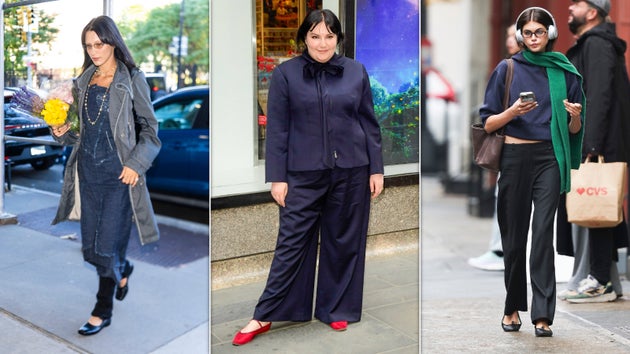
The classic style has been sported recently by Bella Hadid, Hailey Bieber and Kaia Gerber, and Alaïa’s mesh version has been spotted onJennifer Lawrence and Margot Robbie.
Foot experts have thoughts about the dangers of ballet flats, though, including one particular style that’s the absolute worst.
Like this article? Keep independent journalism alive. Support HuffPost.
Here’s the biggest potential issue with ballet flats.
If you’re concerned enough about foot health to try keeping heel height on the low side, you might think that a pair of classic ballet flats will be the perfect choice. You might need to think again, these podiatrists said.
Style: Are You Wearing A MAGA-Coded Outfit? Here's How To Tell.
“If I had to single out one category of style that causes problems, it’s the ballet flat,” Sharkey said. “Yes, they’re easy to slide on and off while looking polished and professional, and they’re a popular choice. Many people wear them for hours on end without realizing the damage they can cause.
“But they typically have no arch support, minimal cushioning and a very thin sole,” she cautioned. “The foot is essentially landing repetitively on a glorified piece of cardboard with every step. Over time, that can lead to arch collapse, chronic heel pain, stress fractures, significant strain on the Achilles tendon and metatarsalgia, which is pain in the ball of your foot.”
“Ballet flats lack foot and ankle support,” said podiatrist Dr. Adenike Sonaike. “Even if you add a custom foot insert, they won’t provide enough support to prevent injury.” Another podiatrist, Dr. Suzanne Fuchs, agreed: “They lack support and overload the plantar fascia,” she said.
“If people understood what was happening to their feet structurally over months and years of daily wear, they’d think twice before reaching for unsupported ballet flats over and over,” Sharkey said.
Style: You’ve Seen This Haircut Everywhere — Barbers Say It’s Been ‘MAGA-Coded’ For Years
And they’re even worse if they’re pointed.
A shoe that ends in a narrow point might also end in foot pain or even misshapen toes over time, podiatrists said. “Narrow, pointy shoes are a major driver of bunions and nerve irritation,” Fuchs said. “This shoe style consistently drives deformity over time.”
“The narrow toe box forces the toes into an unnatural position,” Sharkey explained. “If they’re worn consistently, this can directly contribute to bunion and hammertoe formation. These aren’t just cosmetic issues. They’re a source of pain and are structural deformities that can eventually require surgery.”
“Pointed-toe shoes are consistently the biggest culprit for many foot problems,” agreed podiatric practitioner Marion Yau, co-host of TLC’s “The Bad Foot Clinic.” “The narrow toe box squeezes the toes together, creating concentrated pressure that leads to corns and calluses,” she said. “When the box is severely tight, it can also cause the toes to claw, which jams the toenail against the shoe and damages both the nail plate and the nail bed. The narrower the toe of a shoe, the less room there is for normal toe splay, and the greater the long-term negative impact on the front of the foot.”
How to measure your foot for a better-fitting shoe.
When shopping for shoes, the first step is to get your feet accurately measured. Yau explained, “A significant contributing factor for foot issues, which often surprises patients, is simply wearing the wrong shoe size. Many people have not had their feet measured since childhood and are shocked to discover they’ve been wearing shoes that are too small or too narrow for years. Feet can get longer and wider with age, so an outdated size is more common than most people realize.”
Style: 7 Easy Bedtime Habits That Make You Look Like A Million Bucks In The Morning
Not wearing the right size is a common problem, she said. “Around half my patients are wearing the wrong shoe size and have no idea. That can cause discomfort today and serious issues tomorrow. Wearing shoes that are even half a size too small over many years causes significant, cumulative damage to the nails and toes, so a simple measurement every few years can prevent a lot of unnecessary problems.”
Make sure you compare the measurements of your feet, too, because they may not be the same size. “Shop for the larger foot,” Sharkey said. “It sounds simple, but it prevents an enormous amount of unnecessary pain.”
What to look for in the shoe’s construction.
Once you know the correct size of your larger foot, you’ll want to check for a few key details in shoe construction. Fuchs offered a list of important elements: “First, look for a firm heel counter, which is that rigid, U-shaped area located at the back of a shoe. It should be strong enough to cup the heel, enhance stability and prevent excessive foot motion,” she said. “You want a shoe that has some rigidity and isn’t overly bendy, so if it folds in half easily, it’s not supportive. Look for proper arch support and a wide toe box.”
As you try on shoes, try this trick to make sure the fit is right, Yau said: “You want a thumb’s width of space between your longest toe and the end of the shoe and some give in the width so the shoe doesn’t compress the sides of the foot.”
She added that the shoe has to feel great right that minute. Just like a bad boyfriend, you can’t expect it to change, so don’t engage in magical “this will get better” thinking, whether it’s shoes or men you’re considering. “If a shoe causes pain in the store, don’t assume it will ‘break in,’” she said. “Pain is the foot’s way of telling you the fit is wrong.”
Don’t be fooled by a high price tag.
A high price tag isn’t at all a guarantee of a shoe that’s healthy for your feet, Yau said. “Price is not a reliable indicator, so remember that what matters most is fit and function.”
Sharkey agreed, saying, “I have patients who spend $400 on a designer shoe that offers nothing structurally, and others who spend $90 for supportive shoes that check every box for solid construction.”
Wearing those new shoes every day without a break is a bad idea, these experts said. “It’s not necessarily a problem with one bad pair of shoes, but wearing the same bad shoes every day,” Fuchs said. “Rotation and proper support go a long way.” And when shoes are worn out, get rid of them. “Change your shoes as soon as the shoe loses its original shape or the tread wears down,” Sonaike advised.
Finally, even if you’ve endured foot pain for a long time, you can always try some changes to help them feel better. “Many foot problems attributed to ‘just aging’ are actually the cumulative result of decades of poor footwear,” Sharkey said. “It’s never too late to make better choices, and in many cases, the right shoe, sometimes paired with a custom orthotic, can reverse or significantly reduce symptoms without any other intervention.”